

Pop open a can of Pringles and you are holding one of the most quietly genius pieces of food packaging ever designed. That tall cardboard tube is not just a container. Every inch of it, from the diameter to the curve of each chip inside, was engineered on purpose.
This guide breaks down the real Pringles can dimensions, why they exist, and how they compare across every size on the shelf.
Quick Answer: How Big Is a Pringles Can?
| Measurement | Value |
|---|---|
| Height | 10 in / 25.4 cm |
| Outer diameter | 3 in / 7.6 cm |
| Inner diameter | 2.87–2.9 in / 7.3–7.4 cm |
| Radius | 1.5 in / 3.8 cm |
| Circumference | ~9.4 in / 24 cm |
| Net weight (chips only) | 5.5 oz / 156 g |
| Gross volume | ~25 fl oz / 750 ml |
Standard Pringles Can Dimensions
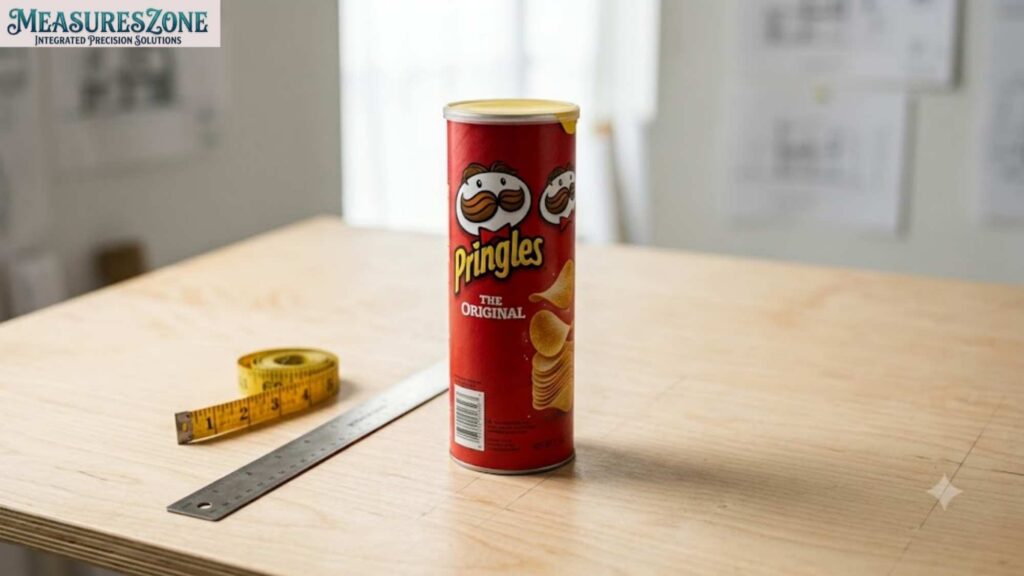
The standard Pringles can is the one you will find in nearly every gas station, grocery store, and vending machine in the country. It is the baseline every other size gets compared to.
Height
The Pringles can height sits at 10 inches, and it is stayed remarkably consistent since the product launched in 1968. That height is not random, it is tall enough to hold roughly 90 to 100 stacked chips without wasting a huge amount of empty space, and short enough to still fit comfortably in a pantry shelf or grocery bag.
Diameter: Outer vs. Inner
Here is something most people never notice: a Pringles canister actually has two diameters. The outer diameter measures about 3 inches, but the inner diameter, the usable space where the chips actually sit, comes in slightly smaller at around 2.87 to 2.9 inches. That small gap accounts for the thickness of the cardboard wall itself.
It is a tiny detail, but it matters if you are ever trying to build a DIY insert or repurpose an empty can, since the inside measurement is the one you actually need.
Radius and Circumference
Do the math and the Pringle can radius works out to roughly 1.5 inches, with a circumference of about 9.4 inches. That circumference number quietly explains why the printed label wraps the can exactly once with barely any overlap, the label size and the can size were clearly designed together, not slapped on afterward.
Volume and Weight
A standard can holds a gross volume of about 25 fluid ounces (750 ml), but the actual Pringles can weight in chips is only 5.5 ounces (156 grams). That is not a packaging mistake. The extra headspace protects the top layer of chips from crushing during shipping and stacking, and it gives the can enough rigidity to survive being tossed around a delivery truck without the tube collapsing.
See the standard Coke can dimensions and sizes.
Pringles Container Sizes: From Mini to Party Size
Not every Pringles container is 10 inches tall. The brand actually produces several different sizes, each built for a different situation, whether for a lunchbox, a party, or somewhere in between.
| Can Size | Weight | Height | Diameter | Approx. Chips |
|---|---|---|---|---|
| Grab & Go / Mini | 1.3–2.5 oz | 4–6 in | 3 in | 30–40 |
| Snack Stack | 2.5 oz | ~5.5 in | 3 in | 40–60 |
| Standard | 5.5 oz | 10 in | 3 in | 90–100 |
| Super Stack | 6.8 oz | ~10.5 in | 3 in | 126–136 |
| Party / Family Size | 10.5–13.5 oz | 11–13 in | 3–3.1 in | 200–300 |
A few things stand out once you line these up side by side:
- The diameter barely changes. Whether you are holding a mini can or a party-size tube, the width stays right around 3 inches. That is a deliberate manufacturing choice, every size uses the same production line and lid tooling, so only the height changes.
- Height does all the work. Instead of making the can wider to hold more chips, Pringles just makes it taller. A wider can would mean redesigning the chip shape entirely.
- Chip count scales almost linearly with height, which tells you the packing density stays consistent no matter which can size you buy.
Why Pringles Cans Are This Exact Shape
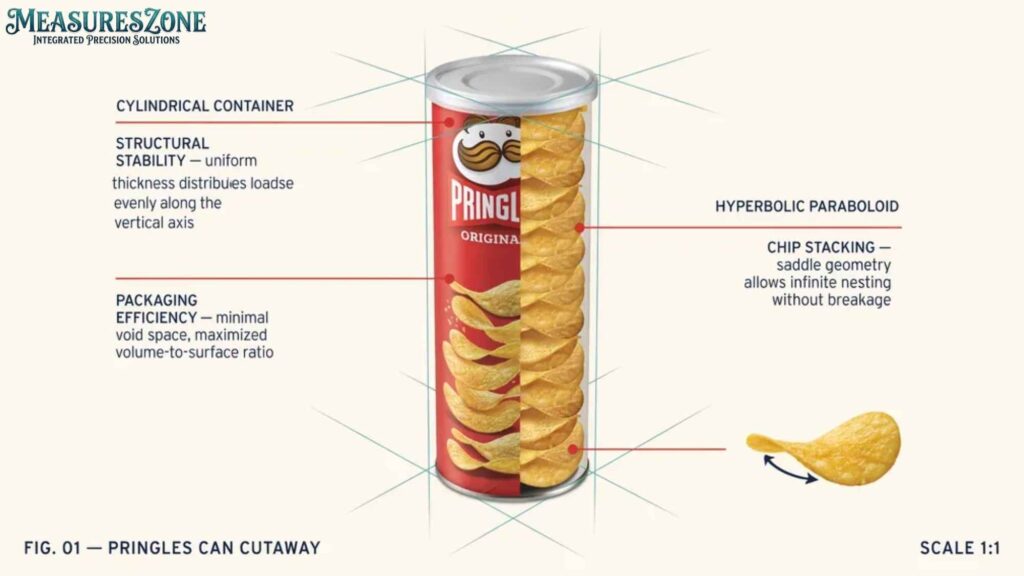
There is a reason this cylindrical snack container has not changed much in over five decades, and it comes down to physics as much as marketing.
The Hyperbolic Paraboloid

Every single Pringle chip is shaped like a hyperbolic paraboloid, essentially a saddle curve, dipping down in one direction and up in the other.
This is not just a fun design flourish. That curved, symmetrical shape lets chips nest perfectly inside one another, distributing weight evenly across the whole stack instead of letting the top chips crush the ones underneath. It is the same structural principle engineers use in saddle-roof architecture, just shrunk down to potato-crisp size.
“The shape allows the chips to be stacked closely together, minimizing breakage and maximizing packaging efficiency,” a description echoed by food engineers whenever they explain why Pringles never bothered with a flat chip.
See how long 6 inches is using everyday objects.
Structural Stability Through Stacking
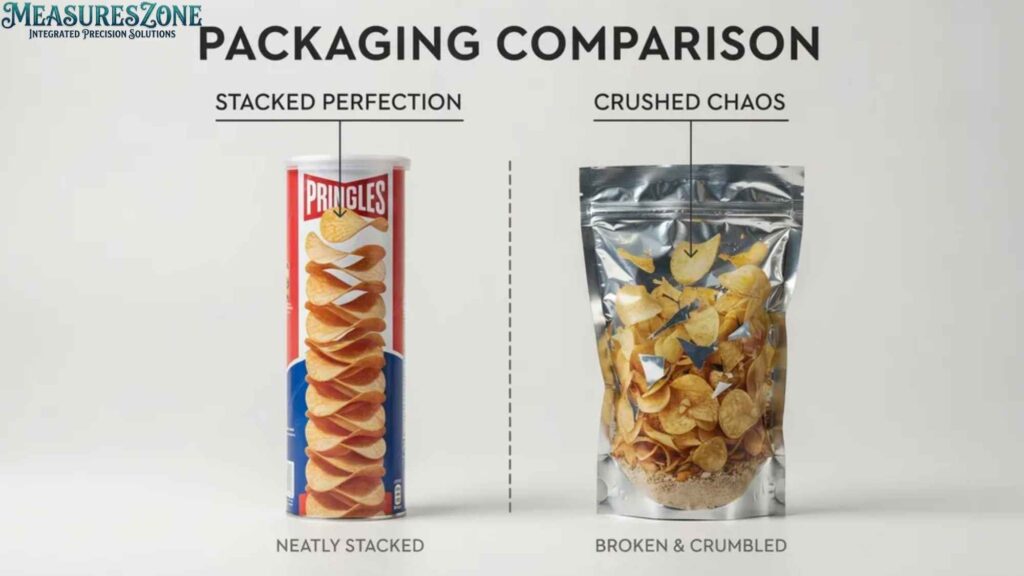
Because each chip curves the same way, the whole column inside the can behaves almost like a single solid rod rather than a loose pile. Compare that to a bag of flat chips, where the ones on the bottom absorb the full weight of everything above them. That is exactly why bagged chips arrive crushed more often than Pringles do.
Shipping and Shelf Efficiency
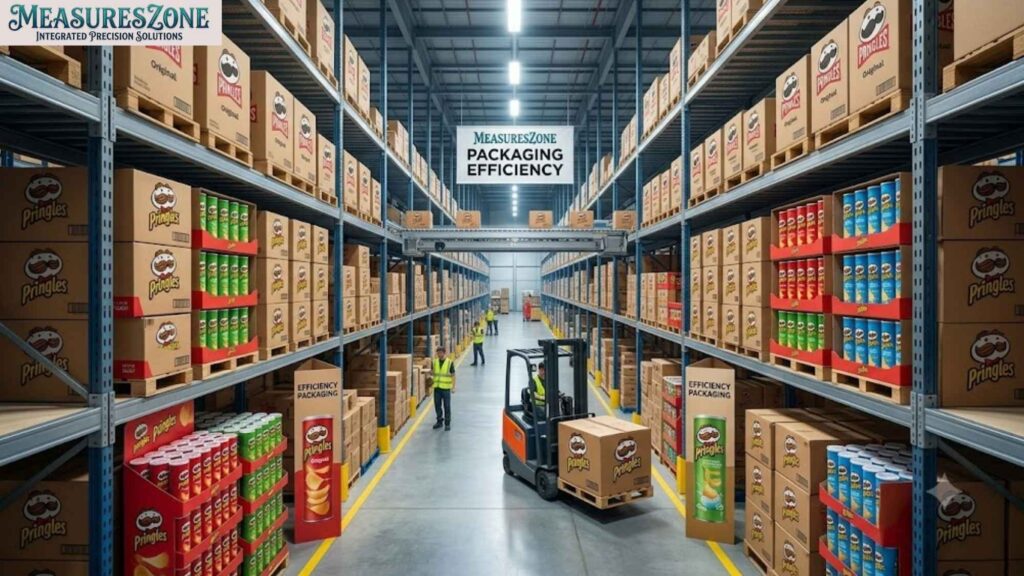
The rigid, uniform cylindrical tube shape also makes warehouse logistics easier. Round cans pack into shipping crates with almost no wasted space, stack cleanly on delivery pallets, and stand upright on store shelves without needing extra support. A flexible bag can not do any of that, it needs to be laid flat or bagged into boxes, which wastes both truck space and shelf space.
Check out these easy ways to visualise 8 inches.
Individual Pringle Chip Dimensions

Zoom in from the can to the individual chip, and the engineering gets even more specific.
- Length: approximately 2.5 to 2.8 inches
- Width: approximately 1.75 inches
- Thickness: approximately 0.06 to 0.09 inches
- Individual weight: roughly 1.5 to 2 grams per crisp
These chip dimensions are not arbitrary, they are built to match the can’s inner diameter almost exactly. A slightly wider chip would not stack cleanly; a slightly narrower one would rattle around and break. The chip was essentially designed around the can, not the other way around, which is a detail most size guides skip entirely.
Pringles Can Size vs. Everyday Objects
Numbers on a page only mean so much. Here is how the standard Pringles can stacks up against things you already have lying around the house.
| Object | Height | Diameter |
|---|---|---|
| Standard Pringles can | 10 in | 3 in |
| 12 oz soda can | 4.8 in | 2.6 in |
| Standard coffee mug | ~4 in | ~3.2 in |
| Monster Energy can | 6.9 in | ~2.6 in |
| AriZona Big Can | 7.6 in | ~3.4 in |
A Pringles can stands roughly twice as tall as a soda can while keeping a nearly identical diameter, which is exactly why it fits into most car cup holders without a problem. The width matches even though the height towers over everything else in the holder.
See how big 10 inches really is with everyday objects.
Practical Uses for Knowing the Dimensions
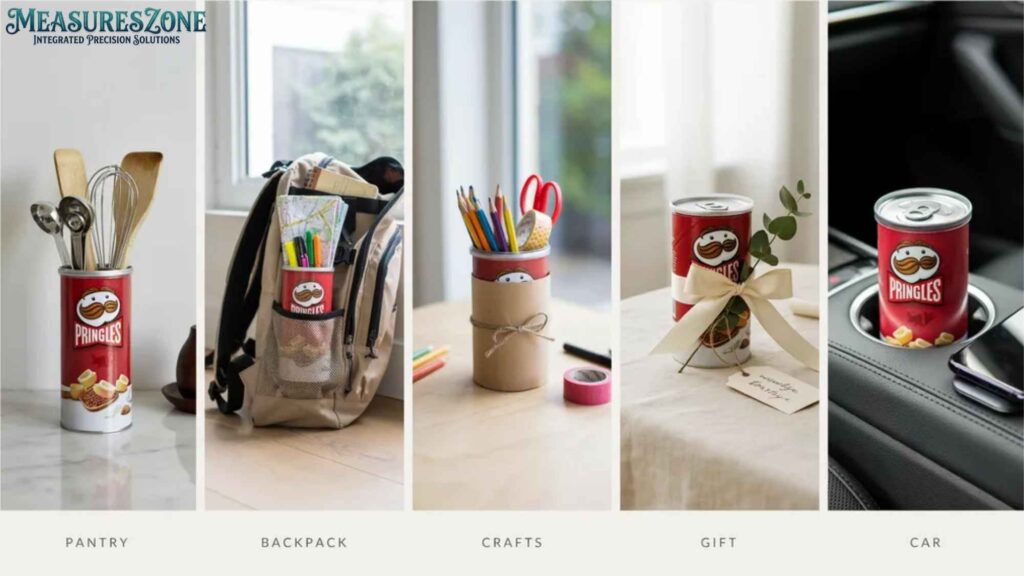
Understanding Pringles packaging dimensions is not just trivia. It is genuinely useful in a few everyday situations:
- Pantry organization: Since the diameter stays consistent across sizes, you can line up mini and standard cans in the same shelf slot without wasted gaps.
- Travel and packing: The 3-inch width slides easily into backpack side pockets and suitcase corners designed for water bottles.
- Crafts and reuse: The known circumference (~9.4 inches) makes it simple to design a custom wrap-around label if you are repurposing an empty can for storage or a gift.
- Cup holder compatibility: With a 3-inch diameter, nearly every standard vehicle cup holder accommodates it without wobbling.
Fun Facts & Records

A few genuinely surprising facts about the world’s most recognizable snack tube:
- World’s Largest Pringles Can: Novelty versions built for promotional events have reached several feet tall, dwarfing the standard container by a huge margin.
- Pringles in Space: In 2011, NASA sent a can of Pringles to the International Space Station, making it one of the first branded snack foods astronauts enjoyed in zero gravity.
- Not Legally “Potato Chips”: Pringles use a pressed dough made from dehydrated potatoes, rice, wheat, and corn instead of sliced whole potatoes, so regulators in the UK and elsewhere classify them as “savory snacks” or “potato crisps” rather than true potato chips.
- The Name’s Origin: According to company lore, the name Pringles came from a street in Cincinnati, Finneytown’s Pringle Drive, near where early trademark research took place.
- Tallest Chip Stack: Enthusiasts have stacked well over 100 individual Pringle chips end to end without a single one cracking, a testament to how consistent the manufacturing tolerances really are.
Here is a quick 10 question quiz based on the guide. It is perfect for an interactive section at the bottom of the post or as a social media or email teaser.
Discover what 100 feet looks like in real life.
Pringles Can Dimensions Quiz
1. How tall is a standard Pringles can?
a) 8 inches b) 10 inches c) 12 inches d) 14 inches
2. What is the outer diameter of a standard Pringles can?
a) 2 inches b) 2.5 inches c) 3 inches d) 4 inches
3. What mathematical shape describes an individual Pringle chip?
a) Parabolic cylinder b) Hyperbolic paraboloid c) Elliptic cone d) Torus
4. How much does a standard can weigh in chips (net weight)?
a) 3.5 oz b) 5.5 oz c) 7.5 oz d) 9.5 oz
5. Roughly how many chips does a standard 5.5 oz can hold?
a) 30–40 b) 60–70 c) 90–100 d) 150–160
Answers
- b) 10 inches
- c) 3 inches
- b) Hyperbolic paraboloid
- b) 5.5 oz
- c) 90–100
Conclusion
Every measurement on that can earns its keep. The 10-inch height stacks 90-plus chips without wasting space, the 3-inch diameter hugs the chip’s own width so nothing shifts or cracks, and even that small outer-to-inner gap comes down to a deliberate cardboard-wall calculation, not sloppy design. Pop the lid, and you are really looking at 50-plus years of engineering that never needed fixing.
Frequently Asked Questions
1. Is a Pringles can recyclable?
Not as a single unit. The cardboard tube, metal base, and plastic lid need to be separated and recycled individually, which most curbside recycling programs do not do automatically.
2. How long do Pringles stay fresh after opening?
Once opened, a can typically stays crisp for about 1 to 2 weeks if the lid is snapped back on tightly between snacking sessions.
3. How much does a standard can cost?
Prices vary by retailer, but a standard 5.5 oz can typically runs between $2 and $3 in most U.S. grocery stores.
Find the exact sizes and dimensions of Monster cans.

Sam Glen is an experienced blogger and the author of the Dimension category at Measures Zone. He specializes in creating accurate, easy-to-understand size and dimension guides, helping readers quickly find reliable information for everyday objects and products.