

You have probably heard someone describe a huge parking lot or a sprawling piece of land as “about the size of a football field.” It is one of the most common size comparisons out there. But how big is a football field, really? And where did these exact football field dimensions even come from?
This guide breaks down every measurement that matters, from the total field length to the width of the hash marks, and then puts those numbers next to things you can actually picture in your head. No fluff, just the real numbers.
The History Behind Football Field Dimensions
Football field dimensions were not handed down from some rulebook in the sky. They were shaped, argued over, and adjusted across decades of trial and error. Understanding the history actually makes the modern layout easier to remember.
Early Football Fields

American football grew out of rugby in the 1860s and 1870s, and early fields reflected that messy origin. Field lengths varied from school to school, sometimes stretching past 140 yards. There were no standardized end zones, no hash marks, and scoring rules changed almost as often as the field itself did.
Walter Camp and the Move to 100 Yards

Walter Camp, often called the father of American football, pushed through a wave of rule changes in the 1880s that gave the sport its own identity separate from rugby.
Among his contributions was the establishment of the 100-yard playing field along with the down-and-distance system. That single decision is the reason the modern game still uses a 100-yard field today.
How the End Zones Got Added

End zones did not show up until 1912. Before that, a player crossing the goal line simply scored, and there was no defined space behind it. The rule change added a 10-yard scoring area at each end, which pushed the total field length from 100 yards to the 120 yards we know now.
This also gave us the term “end zone” and formally created the touchdown area as its own section of the field.
Why Hash Marks Exist
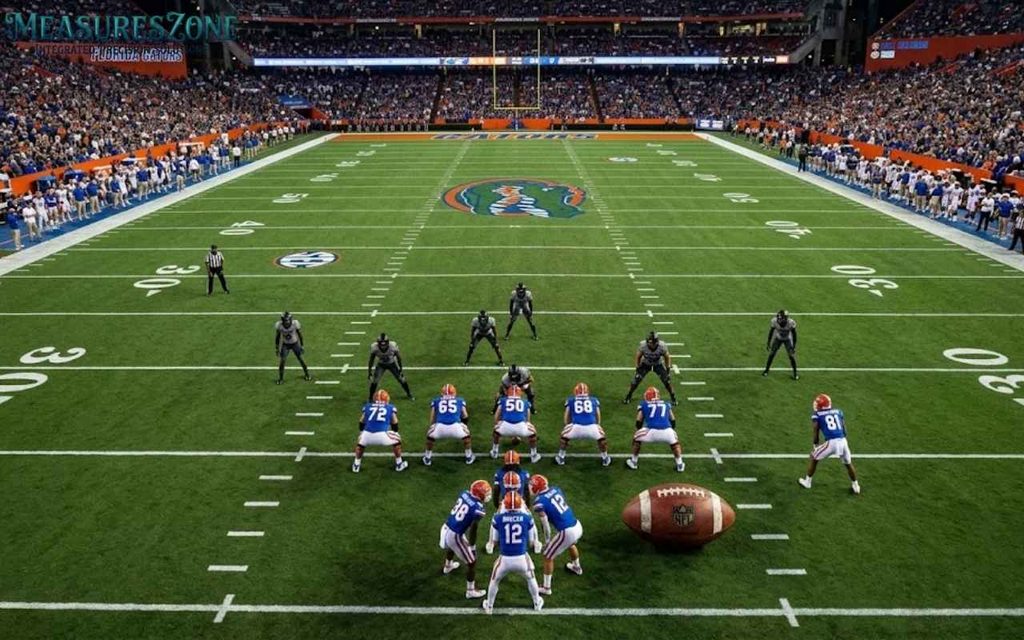
Hash marks came later, introduced to keep the ball from getting stuck too close to the sideline after a play. Without them, a tackle near the boundary would force every following play to happen in a cramped sliver of field, which made the game harder to watch and harder to play.
The exact hash mark spacing has shifted over the decades and still varies today between the NFL, college, and high school levels, which we will cover in detail below.
Football Field Dimensions, Broken Down Part by Part
Now let’s zoom in. A regulation field is not just one big rectangle. It is made up of several distinct sections, each with its own exact measurement.
Total Field Length (Including End Zones)

The total field length, end zone to end zone, is 120 yards, or 360 feet. This is the number you would measure if you walked from the very back of one end zone to the very back of the other.
Playing Field Length (Goal Line to Goal Line)
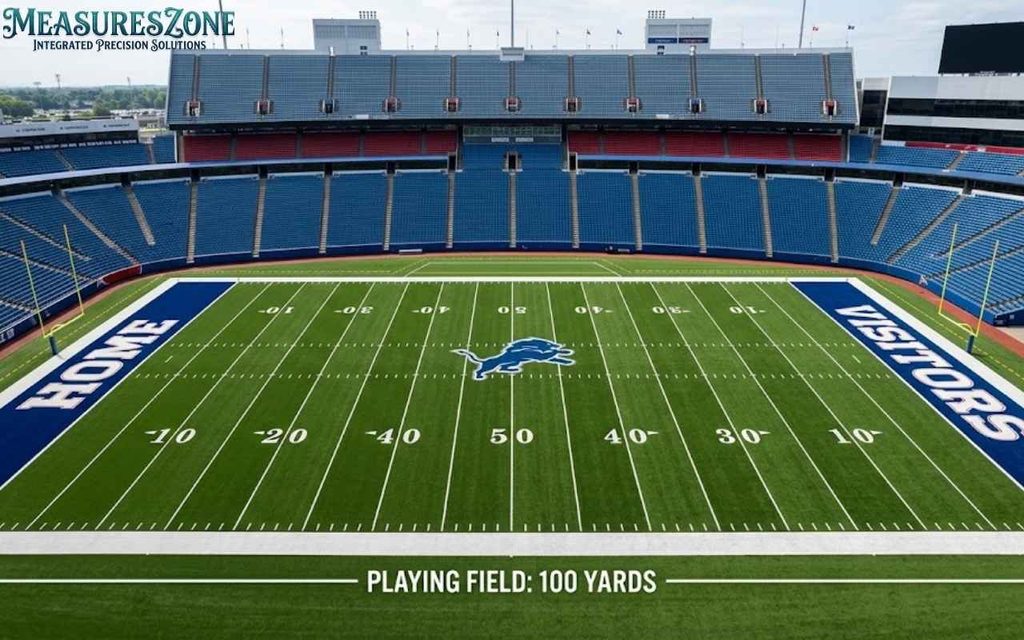
Strip away the end zones and you are left with the actual playing field length: exactly 100 yards, or 300 feet, from one goal line to the other. This is the “field of play” where the bulk of the game happens and where the down markers matter most.
Football Field Width

Sideline to sideline, a regulation field measures 53⅓ yards, or 160 feet. That odd fraction trips people up, but it comes from the field’s origin in rods, an old English unit of measurement. One rod equals 16.5 feet, and the field width works out to exactly 10 rods. It is a strange bit of trivia, but it explains the standard width instead of a cleaner, rounder number.
Visualize 3 inches with everyday objects.
Football Field End Zone Dimensions

Each end zone runs 10 yards deep and spans the full 160-foot width of the field. Two end zones combined add 20 yards to the field’s total length, which is where that 100-yard playing field turns into a 120-yard total field length.
Football Field Yard Lines and Numbers
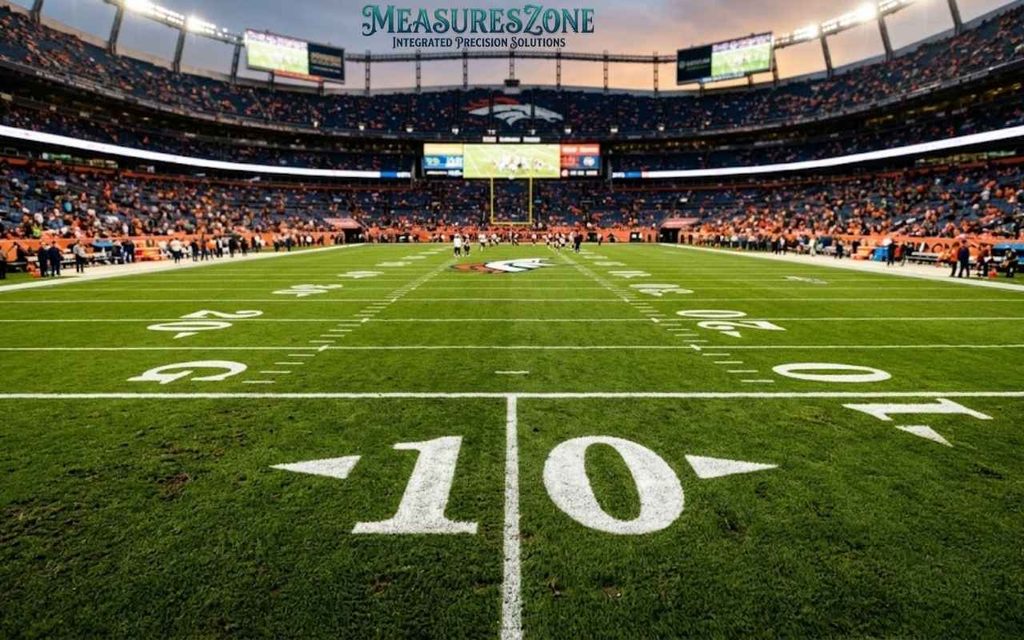
Yard lines are painted every 5 yards across the field, with bold numbers marking each 10-yard interval. The numbers count up from each goal line to the 50-yard line at midfield, then count back down toward the opposite end zone.
Small arrows next to each number point toward the nearer end zone, which helps players and officials instantly judge field position during a fast-moving play.
Football Field Hash Marks
Hash marks are short lines that run down the middle of the field in two parallel rows. Every play must start with the ball placed on or between the hash marks, which keeps the field of play from getting bunched up on one side. Hash mark spacing is one of the few measurements that actually changes by level:
| Level | Hash Mark Distance from Sideline |
|---|---|
| NFL | 70 feet, 9 inches |
| College (NCAA) | 40 feet |
| High School (NFHS) | 53 feet, 4 inches |
NFL hash marks sit closer together and closer to the center of the field, which is part of why pro passing games can operate from a wider variety of angles. College hash marks sit much farther toward the sidelines, and high school hash marks land somewhere in the middle.
See how 4 inches compares to everyday objects.
Football Field Goal Lines

The goal line marks the boundary between the playing field and the end zone. It is painted white and technically counts as part of the end zone itself, meaning the ball just needs to break the plane of the goal line to count as a score.
Sidelines and End Lines

Sidelines run the full 360-foot length of the field along both sides, and end lines close off the back of each end zone. Both are considered out of bounds the instant a player or the ball touches them.
Goal Posts
Goal posts sit at the back of each end zone, right on the end line. The crossbar sits 10 feet off the ground, and the uprights extend well above it. Goal post spacing (the distance between the uprights) is 18 feet, 6 inches in the NFL and college, and slightly different for some youth levels.
The uprights themselves stretch at least 20 feet above the crossbar at most levels, and even taller at some professional stadiums for better sightlines from the stands.
Field Surface
Grass and turf fields share identical dimensions, but the surface changes how the game plays. Turf tends to produce a faster game with more consistent footing, while grass fields can slow down late in the season as weather wears down the surface. Either way, the standard field size stays the same.
Field Dimensions by Level of Play
Not every level of football uses the same regulation field. Here is how the numbers stack up:
| League | Field Length | Field Width | End Zone Depth |
|---|---|---|---|
| NFL | 120 yards | 53⅓ yards | 10 yards |
| NCAA (college) | 120 yards | 53⅓ yards | 10 yards |
| High School (NFHS) | 120 yards | 53⅓ yards | 10 yards |
| CFL | 150 yards | 65 yards | 20 yards |
| Youth / Pop Warner | Often 80 or 100 yards total | Varies by age group | Often 8 yards |
The CFL is the real outlier here. A Canadian football field runs 110 yards of playing field plus two massive 20-yard end zones, and it is also noticeably wider than an American field. That extra size is part of why the Canadian game plays faster and looser, with more room for lateral movement.
How Big Is a Football Field, Really? 9 Real-World Comparisons
Numbers on a page only go so far. Here are some size comparisons that make the scale of a football field click.
A soccer pitch
A football pitch used in international soccer is not fixed to one exact size, but a standard match pitch (around 115 by 74 yards) is both longer and wider than an American football field. Most people assume they are roughly the same. They are not even close.
Visualize 18 inches with everyday objects.
A basketball court
An NBA court measures 94 by 50 feet. You could fit more than four full basketball courts inside a single football field with room to spare.
An acre of land
A football field, end zones included, covers about 1.32 acres. That busts the popular myth that a football field equals exactly one acre. The playing field alone, without end zones, comes closer to 1.1 acres.
An Olympic swimming pool
A regulation Olympic pool is 50 meters long, or about 164 feet. Roughly two pools laid end to end would stretch the length of a football field.
A Boeing 737
A Boeing 737 measures around 110 to 130 feet long depending on the model, meaning nearly three of them could line up nose to tail across a single field.
The Statue of Liberty
From the base of the pedestal to the tip of the torch, Lady Liberty stands about 305 feet tall. Laid on her side, she would stretch across most of the field’s length.
A blue whale
The largest animal on Earth can reach up to 100 feet long. Even the biggest blue whale ever recorded would only cover about a third of a football field’s length.
A city block
This one needs a caveat. City blocks vary enormously depending on the city, but a typical Manhattan block runs about 264 feet along its long side, which is shorter than the field’s total length but longer than the playing field width.
A cruise ship
Some of the largest modern cruise ships stretch past 1,180 feet, meaning a single ship could be more than three football fields long stacked end to end.
How to Measure a Football Field Yourself

Whether you are marking out a backyard field or checking a local park’s layout, measuring a regulation field is straightforward with the right approach.
Tools You Will Need
- A measuring wheel or a long tape measure (100 feet or longer)
- Marking flags, cones, or field chalk
- A helper to hold the far end of the tape
- A notepad to track measurements as you go
Step by Step Process
- Pick a straight edge or existing line to use as your starting sideline.
- Measure and mark the field width first, since it is a fixed 160 feet.
- Run your tape or wheel along the sideline to mark the full 360-foot total length.
- Measure in 30 feet from each end to mark the two end zone lines, leaving 300 feet of playing field length in between.
- Mark 5-yard intervals across the playing field, adding bold numbers every 10 yards.
- Measure and mark hash marks based on the level of play you are recreating.
- Square off all four corners using a right-angle check to keep the field true.
Common Mistakes to Avoid
- Forgetting to include the end zones when marking total field length
- Confusing the sideline with the actual edge of the field of play, which are two different lines
- Not accounting for the field’s crown or slope, which can throw off flat measurements on grass fields
- Mixing up hash mark spacing between NFL, college, and high school specs
Learn about tiny house sizes and dimensions.
frequently asked question
Curious about a few more specifics before you go? Here is a quick rundown of the questions people ask most about football field size and layout.
How much does it cost to build a regulation football field?
A basic grass field can cost $50,000 to $100,000 to build, while synthetic turf fields often run $600,000 to over $1 million depending on drainage, lighting, and stadium seating.
Why do football fields face north to south?
Most outdoor fields are oriented north-south to reduce the amount of time players face directly into a low sun during sunrise or sunset games.
How long does it take to install a turf football field?
Installation typically takes 4 to 8 weeks, covering base prep, drainage work, turf laying, and infill application before the field is game-ready.
Do indoor football fields follow the same dimensions?
Yes, indoor stadiums like domes use the same regulation length and width as outdoor fields, though some arena football variants use shorter, narrower fields.
How often does a grass football field need to be replaced?
Natural grass fields are usually resodded once a year, while turf fields typically last 8 to 10 years before needing replacement.
Key Takeaways
A regulation football field is 120 yards long and 53⅓ yards wide, including two 10-yard end zones. Hash marks vary by level, and the goal posts have a 10-foot crossbar.CFL fields are larger at 150 yards by 65 yards, while a standard American football field covers about 1.32 acres.
Whether you are watching a game or simply curious about its size, knowing the field’s dimensions makes it much easier to picture just how massive a football field really is.
Football Field Dimensions Quiz
Test your knowledge of football field dimensions with these five quick questions. See how many answers you can get right!
1. How long is a standard American football field including both end zones?
A. 100 yards
B. 110 yards
C. 120 yards
D. 150 yards
2. How wide is a standard American football field?
A. 50 yards
B. 53⅓ yards
C. 60 yards
D. 65 yards
3. How deep is each standard American football end zone?
A. 5 yards
B. 8 yards
C. 10 yards
D. 20 yards
4. How high is the crossbar of a standard football goal post?
A. 8 feet
B. 10 feet
C. 12 feet
D. 15 feet
5. How many acres does a standard American football field cover, including the end zones?
A. 0.75 acres
B. 1.00 acre
C. 1.32 acres
D. 2.00 acres
Answers
- C) 120 yards
- B) 53⅓ yards
- C) 10 yards
- B) 10 feet
- C) C. 1.32 acres
See how long 7 inches is in real life.

Sam Glen is an experienced blogger and the author of the Dimension category at Measures Zone. He specializes in creating accurate, easy-to-understand size and dimension guides, helping readers quickly find reliable information for everyday objects and products.