

Picture a lake so dense that you can lounge on your back and read a newspaper. It exists. The Dead Sea sits at the lowest point on Earth’s dry land. Its mineral-rich water has drawn kings, priests, and scientists for thousands of years.
This guide covers the Dead Sea dimensions, the Dead Sea history, and the science behind its extreme saltiness. You’ll also see why the lake is shrinking. Every figure carries a year because this lake changes fast.
Dead Sea Quick Facts at a Glance
| Feature | Measurement |
|---|---|
| Surface elevation (2025) | 439.78 m (1,443 ft) below sea level |
| Surface area (2016) | 605 km² (234 sq mi) |
| Maximum depth | About 298 m (978 ft) |
| Average depth | 188.4 m (618 ft) |
| Water volume | 114 km³ |
| Length and lake width | About 50 km by 15 km |
| Shoreline length | 135 km (84 mi) |
| Salt concentration | About 34% |
The big takeaway: the Dead Sea is lower, saltier, and far smaller than it was a century ago.
What Makes This Lake So Unusual?
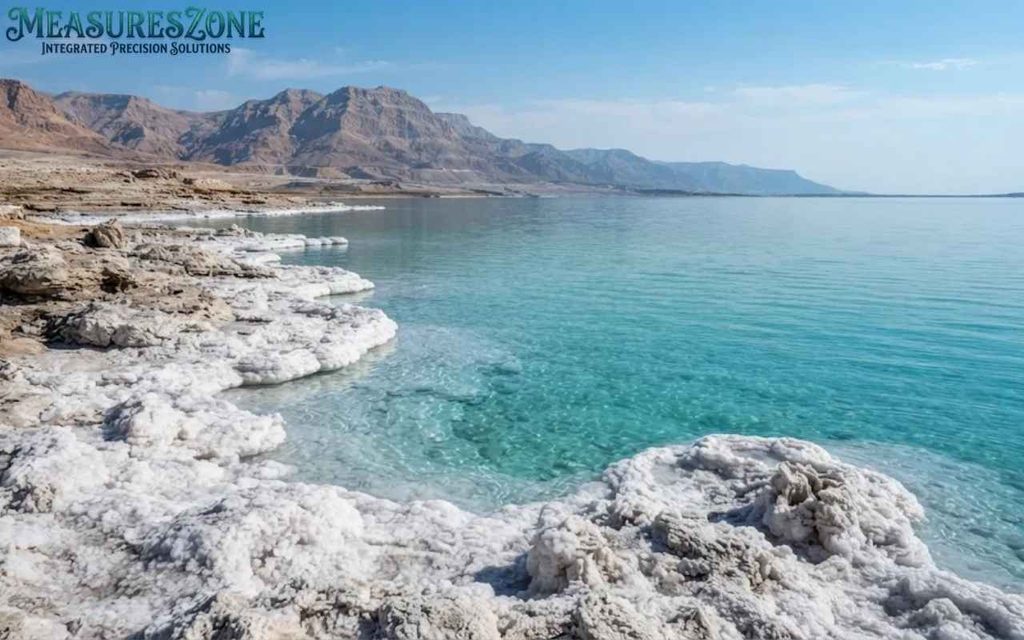
Despite the name, the Dead Sea is a saltwater lake. More precisely, it’s a hypersaline lake with no outlet to any ocean. Jordan hugs its eastern side. Israel and the West Bank lie to the west.
Hebrew speakers call it Yam ha-Melah, the Salt Sea. Arabic names include Al-Bahr al-Mayyit and Bahr Lut, the Sea of Lot. Scientists call lakes like this endorheic. The main source of water inflow is the Jordan River. The only exit is evaporation.
Today the lake has two halves. The northern basin holds the deep, open water. The southern basin now works as evaporation ponds for the mineral industry. According to EBSCO, operators pump water from north to south to keep them filled.
Dead Sea Dimensions: Lake Measurements Explained
Lake measurements sound simple. They aren’t. The surface drops every year, so every number needs a date.
The Dead Sea’s surface area measured 605 square kilometers in 2016. In 1930 it covered about 1,050. That’s a loss of roughly 42 percent. The northern basin stretches about 50 kilometers long. Its lake width tops out near 15 kilometers.
The maximum depth sits near 298 meters. The deepest point of the lakebed lies 728 meters below sea level. The shoreline length is 135 kilometers, but the Dead Sea shoreline keeps moving. Treat that figure as a snapshot.
You may see different numbers on different websites. Nobody’s wrong. Here’s how the surface elevation changed:
- 418 m below sea level: older encyclopedias
- 430.5 m: a 2016 measurement
- 439.78 m: the 2025 figure
Depth varies too. The 298-meter figure subtracts an earlier surface level from the 728-meter lakebed. Using the 2025 surface gives about 288 meters. That’s my own arithmetic and not a published survey. Still, it shows how fast the numbers move.
For scale, Lake Titicaca sits 3,812 meters above sea level. Nepal’s Tilicho Lake rises to 4,919 meters. More than 5,300 meters of elevation separate it from the Dead Sea, according to Brilliant Maps and Wikipedia.
The Lowest Point on Earth: How It Formed
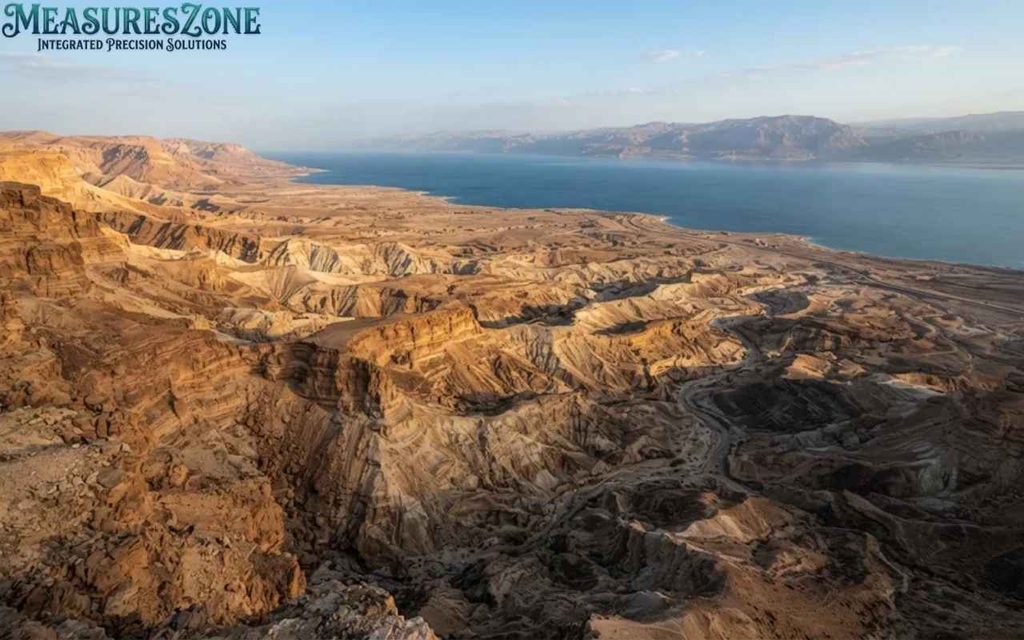
The lake sits inside the Dead Sea Rift, part of the Great Rift Valley. Earth’s crust here has stretched and sunk. The result is a deep basin in the Jordan Valley. At 439.78 meters below sea level, the shore is the lowest point on Earth on dry land.
Geologists still debate the details. One hypothesis points to about 2.5 million years ago, when global sea level stood 50 to 100 meters higher. Ocean water flooded valleys leading to the rift. When the sea fell, a lagoon stayed behind. A rival view credits tectonic movement alone.
The lake also had an ancestor. Lake Lisan peaked about 26,000 years ago during a very wet climate. Around 10,000 years ago it dropped sharply. Evaporating ancient lakes left thick underground salt deposits. Remember them. They matter when we reach sinkholes.
See what 300 ml looks like in everyday containers.
Dead Sea Salinity: Why the Water Is So Salty
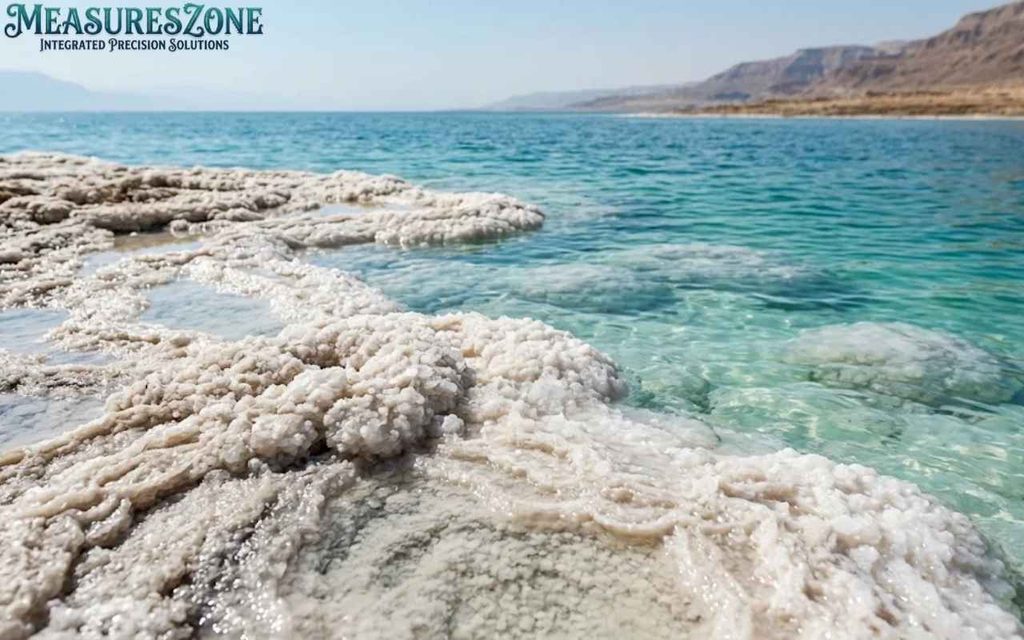
Ocean water tastes salty. Dead Sea water tastes like a punishment. Here’s why.
Rain is scarce. The northern shore gets about 100 millimetres per year. Meanwhile the desert sun bakes the surface. Rivers deliver small amounts of dissolved salts. Evaporation removes only pure water. Think of soup left on the stove. The water steams away. The salt stays put.
- Dead Sea: about 34% salt concentration
- Typical ocean salinity: about 3.5%
- Result: nearly 10 times saltier
Geography Worlds reports the same figure. Experts call such extremes hypersalinity.
The mineral content of this high-salinity water includes magnesium, potassium, and bromine. Sodium chloride dominates the ocean. In the Dead Sea, magnesium and other minerals claim a much bigger share. That mix makes it a true mineral-rich lake.
Fish and plants can’t survive. Some microscopic organisms tolerate the saline water. So the name is mostly right.
Why You Float: Dense Water Explained

The floating experience is simple physics. This dense water has a density near 1.24 kilograms per liter. Fresh water measures 1.00 and ocean water about 1.03. Your body is only slightly denser than fresh water. So you bob like a cork.
A few visitor tips keep floating safe:
- Wade in slowly and sit down before you lean back.
- Keep splashes away from your eyes and mouth.
- Skip shaving beforehand. Fresh nicks sting badly.
- Stay in for 15 or 20 minutes and rinse afterward.
Ancient Civilizations and Biblical Records
The Hebrew Bible calls the lake the Salt Sea. Biblical history sets several famous stories near its shores. That link gave the lake deep cultural weight.
Natural asphalt blobs rise from the lakebed. Ancient Egyptians used this material in mummification, per Geography Worlds. The Nabataeans, who controlled nearby trade routes, harvested it too. Few lakes shaped ancient civilizations this way.
During the Roman era the area became a strategic frontier. Herod the Great built fortress palaces here. Masada is the most famous. Roman forces ended the Jewish revolt there around 73 CE. Large-scale potash mining began in the early 20th century. Dead Sea Works operates on the Israeli side. Jordan’s Arab Potash Company works the southeast shore.
Explore how tall 1000 feet looks in real life.
Dead Sea Scrolls: Qumran Manuscripts Explained
The most famous find here isn’t water. In 1947 the first scrolls turned up in caves near Qumran. The Dead Sea Scrolls reshaped our view of Judaism and early Christianity.
- Location: the Qumran Caves on the northwest shore
- Era: the Second Temple period, roughly the 3rd century BCE to the 1st century CE
- Size: about 900 manuscripts
- Content: ancient biblical texts, commentaries, and community rules
The Qumran manuscripts include copies of nearly every book of the Hebrew Bible. Only Esther is missing. They’re roughly a thousand years older than most manuscripts known before. The dry air preserved them. These historical scrolls also describe a community that lived nearby. Their historical significance is hard to overstate. Archaeological discoveries around Qumran still add detail.
Dead Sea Mud and Minerals: What the Healing Claims Hold Up
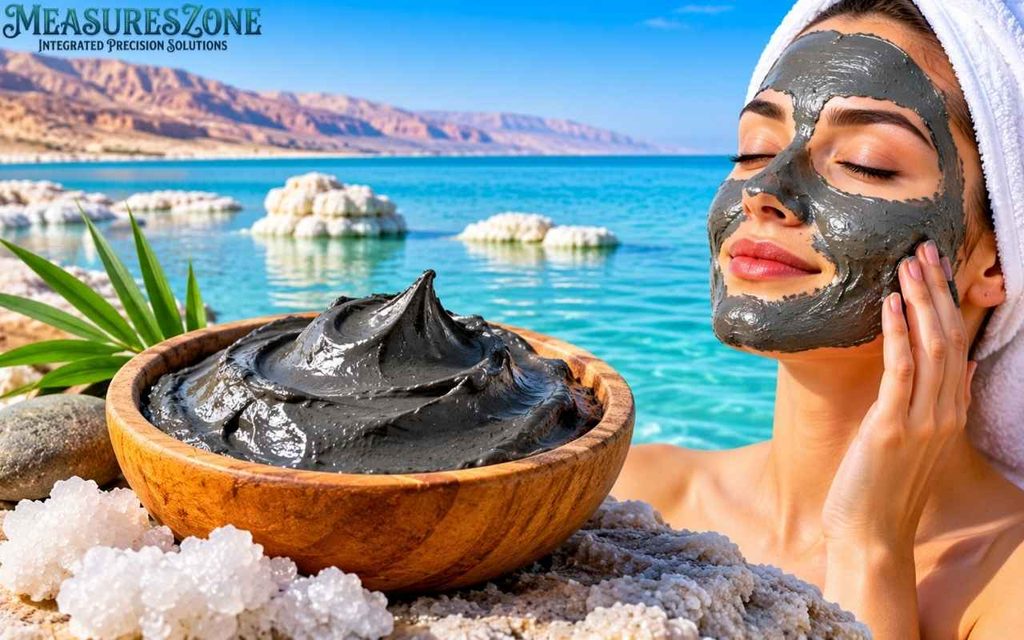
Visitors smear gray-black mud on their skin and wait for it to dry. Dead Sea mud is a mineral mud. It carries the same family of minerals found in the water. Sellers call it therapeutic mud or healing mud. Those labels sound impressive. They aren’t medical claims.
The area’s medical reputation grew from its climate. The air has less ultraviolet radiation and higher atmospheric pressure. That helps with skin conditions like psoriasis.
A basic mud treatment is simple. Patch test first and avoid open wounds. Apply a thin layer for 10 to 15 minutes. Rinse well. Treat it as a pleasant natural skincare ritual and not a proven cure.
Why the Lake Is Shrinking
Three forces drive the decline. First comes river diversion. Around 1948 about 1.4 billion cubic meters of water flowed in each year. Diversions for drinking water and farming slashed that flow. Competing demand on the freshwater supply keeps pressure high. Scientists say at least 650 million cubic meters per year would stabilize the sea, per J. Weekly.
Second comes mineral extraction. Companies such as Dead Sea Works remove about 150 million cubic meters per year. NBC News reported that about 30 percent of the drop comes from mining. Third, hotter weather speeds evaporation.
| Period | What happened |
|---|---|
| 1930 | Surface area about 1,050 km² |
| Mid-1970s onward | Level falls more than 25 m |
| 1993 to 2009 | Drop of 1.15 m per year |
| Later period | Drop of about 1.33 m per year (Yale) |
| 2025 | Surface at 439.78 m below sea level |
Case study: the southern basin. Salt piles up on the pond floors there. Reports describe it raising the water level about 20 centimetres a year, which threatens roughly a dozen hotels. Meanwhile the open lake falls. Engineers keep the system running by pumping.
See how long 1 inch is with everyday objects.
Dead Sea Sinkholes: Ground Collapse Along the Shoreline
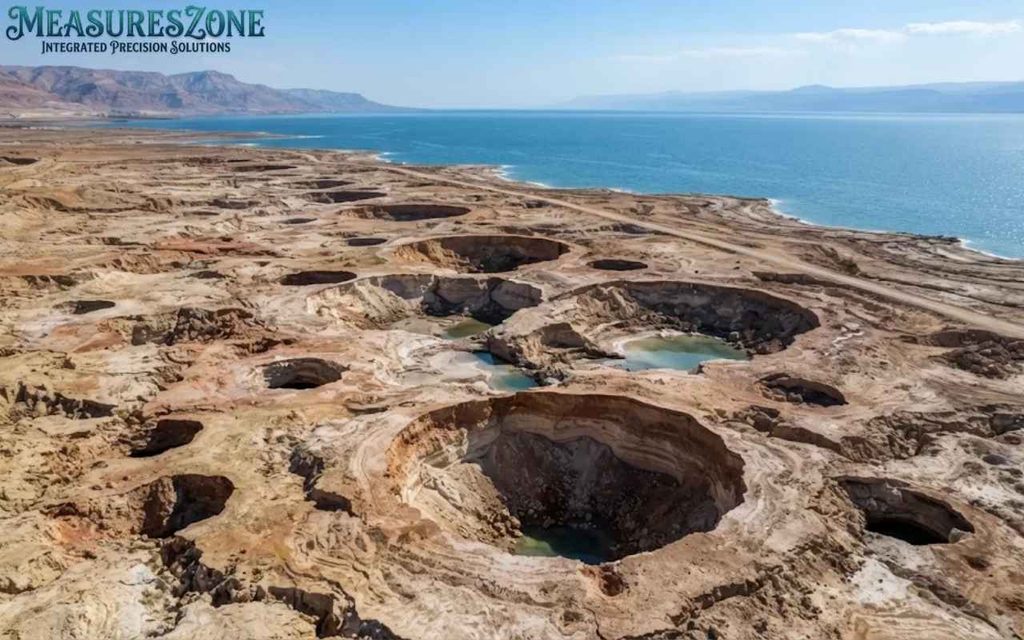
Look at the Dead Sea shoreline from above and you’ll see craters. As the lake retreats, fresh groundwater dissolves underground salt deposits. Voids open up. Eventually the surface gives way. The result is sudden ground collapse.
- About 6,000 coastal sinkholes now dot the lake coast, per Culture Trip.
- Geologists estimate 400 to 500 new ones appear each year.
- Some reach about 80 feet across.
Falling water also fuels soil erosion in nearby valleys. These geological hazards damage roads, farmland, and buildings.
Dead Sea Environment: Ecosystem Damage and an Environmental Crisis
The Dead Sea environment suffers on several fronts. Groundwater drops along with the lake. Springs and oases lose flow. Ecosystem damage spreads inland. Coastal retreat is dramatic. Geography Worlds reports that the shoreline pulled back hundreds of meters in places. That shoreline decline leaves old beaches far from the water.
Some places still protect nature. Wadi Mujib in Jordan is a biosphere reserve covering 212 square kilometers. Water sustainability sits at the heart of this crisis. Israel, Jordan, and Palestine share limited water. Every cubic meter diverted from the Jordan River is one the lake never receives.
Saving the Dead Sea: Conservation Efforts and River Restoration
Conservation efforts have focused on one big idea: bring in more water. The Red-Dead project would move water about 112 miles from the Red Sea. Phase one planned 300 million cubic meters per year at an estimated $900 million, according to Israel National News. A related plan included a $1.5 billion desalination facility, per NBC News. Experts told NBC the plan is a drop in the bucket. They say stabilizing the sea takes about ten times that amount.
Critics also question the goal. One expert quoted by Yale called it a “drinking water for Amman” project. Environmental groups worry that mixing Red Sea water with Dead Sea brine could change the lake’s chemistry.
River restoration offers another path. More Jordan River flow means more natural water inflow. Yale’s reporting adds that better management could free about 300 million cubic meters of water for Amman. Smart policy may beat any pipeline.
Dead Sea Tourism: Travel Attractions and Visitor Tips

Dead Sea tourism thrives despite the lake’s troubles. Travelers come for the floating experience, the spas, and the history. Resort strips and beach destinations line both the Israeli and Jordanian shores. Because the lake keeps retreating, beach access changes yearly.
These travel attractions make great sightseeing:
- Masada: Herod’s cliff-top fortress with sweeping lake views
- Ein Gedi Nature Reserve: a desert oasis with waterfalls and trails
- Qumran National Park: the site beside the Qumran Caves
- Wadi Mujib: Jordan’s canyon reserve for water hikes
More visitor tips: pack sunscreen because filtered UV isn’t zero UV. Bring water shoes for sharp salt crusts. Drink plenty of fresh water. Stick to marked beaches since unmarked areas may hide sinkholes.
Discover what 100 acres looks like in real life.
Frequently Asked Questions
Find quick answers to common questions about the Dead Sea.
When is the best time to visit the Dead Sea?
Spring and fall are ideal, with mild temperatures and lower humidity. Summer gets extremely hot, while winter days remain mild and sunny.
How do you get to the Dead Sea?
From Jerusalem, the drive takes about an hour, while Amman Airport is roughly 45 minutes away. Public buses also run from Jerusalem, but departures are limited. Day trips from Amman, Tel Aviv, and Jerusalem are popular.
Can you drink Dead Sea water?
No. With a salt concentration near 34 percent, a few gulps can cause vomiting and dehydration. Treat the lake as a place to float and never as a source of drinking water. Carry plenty of fresh water instead.
Can you drown in the Dead Sea?
Floating is easy, but swallowing or inhaling the salty water can be dangerous. Stay near shore, float on your back, and keep children under close supervision.
Is the Dead Sea the saltiest water on Earth?
The Dead Sea is among the world’s saltiest lakes, but a few smaller bodies of water, such as Antarctica’s Don Juan Pond, are saltier. However, it is the largest hypersaline lake known for its floating experience.
Conclusion
The Dead Sea packs a lot into one remarkable lake. Its dimensions reveal a shrinking giant, with a surface area of 605 square kilometres. Thanks to its extreme salinity, the dense water allows visitors to float effortlessly. Its rich history stretches from biblical times and the Dead Sea Scrolls to modern potash mining.
The lake also tells a warning story. Sinkholes, coastal retreat, and lost water all connect. This lowest point on Earth keeps getting lower. That makes an earlier visit worth considering.
Dead Sea Quick Quiz
Test your knowledge of the Dead Sea with this quick quiz covering its dimensions, history, salinity, and unique features.
1. Where does the Dead Sea surface sit in 2025?
A) 100 meters below sea level
B) 439.78 meters below sea level
C) 439.78 meters above sea level
D) Exactly at sea level
2. What is the approximate salt concentration of the Dead Sea?
A) 3.5%
B) 10%
C) 34%
D) 60%
3. Why can you float so easily in the Dead Sea?
A) The water is extremely hot
B) The water is very dense, near 1.24 kg/L
C) The lake is very shallow
D) The mud lifts your body
4. When were the first Dead Sea Scrolls discovered?
A) 1847
B) 1947
C) 1987
D) 1907
5. Which river is the main source of water inflow for the Dead Sea?
A) Nile
B) Euphrates
C) Jordan River
D) Tigris
Answer Key
1. B(439.78 meters below sea level)
2. C(34%)
3. B(The water is very dense, near 1.24 kg/L)
4. B(1947)
5. C(Jordan River)
Compare Gatorade bottle sizes and dimensions.

Sam Glen is an experienced blogger and the author of the Dimension category at Measures Zone. He specializes in creating accurate, easy-to-understand size and dimension guides, helping readers quickly find reliable information for everyday objects and products.