

How tall is 1000 feet? It equals 304.8 meters, 333 yards, or about one-fifth of a mile. Those figures sound tidy on paper. They feel abstract until you stand at the bottom of a 1000-foot structure and look up.
Picture Paris in 1889. Crowds stared at something no human had built before: a structure that climbed past one thousand feet. This guide turns those figures into real-life comparisons, building heights, climbing times, and a height comparison table. By the end you will see 1000 feet tall the way an architect does.
How Tall Is 1000 Feet? The Quick Answer
Start with the numbers. Here is every common measurement conversion for 1,000 ft.
| Unit | Equivalent of 1,000 ft |
|---|---|
| Meters | 304.8 m |
| Yards | 333.3 yd |
| Inches | 12,000 in |
| Miles | 0.189 mi |
A fast rule of thumb helps. Multiply feet by 0.3 to get meters. You land on 300, which sits very close to the exact answer.
Why the 1000-Foot Mark Matters
Engineers treat the 1000-foot mark as a height milestone for good reason. Wind forces, elevator speeds, and structural loads all change at this level. Builders cannot simply stack more floors on a normal frame.
The Council on Tall Buildings and Urban Habitat (CTBUH) sets its supertall skyscraper line at 300 meters, or 984 feet. A 1000-foot structure clears that skyscraper threshold with room to spare. You can track these records in the Skyscraper Centre database.
How Tall Does a 1000-Foot Structure Look in Real Life?

Numbers fool our eyes. A 1000-foot height looks smaller in photos than it really is.
Why People Underestimate One Thousand Feet
Your brain judges size by comparison. A lone tower on an open plain has nothing nearby to measure against. Distance adds to the trick, since a massive tower seen from half a mile away looks like a thin pencil.
What Standing Beside a 1000-Foot Structure Feels Like
Tilt your head back at the base. You would need to step back about 1,000 feet to see the top at a comfortable 45-degree angle. Close up, the upper floors fade into haze. A six-foot person equals just 0.6 percent of the structure’s vertical height.
How Many Stories Is 1000 Feet?
The answer depends on floor heights. A 1000-foot skyscraper holds anywhere from 70 to 100 floors.
Standard Floor Height by Building Type
Offices need room for ductwork and ceiling systems. Apartments can squeeze tighter.
| Building type | Typical floor height | Floors in 1,000 ft |
|---|---|---|
| Commercial buildings | 12 to 14 ft | About 71 to 83 |
| Hotels and mixed-use | 10 to 12 ft | About 83 to 100 |
| Residential structures | 9 to 10 ft | About 100 to 111 |
A 90-story building at about 11 feet per floor reaches roughly 990 feet. A 100-story tower with 10-foot floors hits the 1000-foot height almost exactly.
Why Stories Don’t Match 1000 Feet of Height
Lobbies, mechanical floors, and spires add vertical height without adding usable space. Two real examples prove it:
- The Chrysler Building has 77 floors and stands 1,046 ft with its spire.
- The Shard in London has 72 habitable floors and rises 1,016 ft (official site).
Same height range. Very different floor counts.
Famous Towering Buildings Near the 1000-Foot Mark
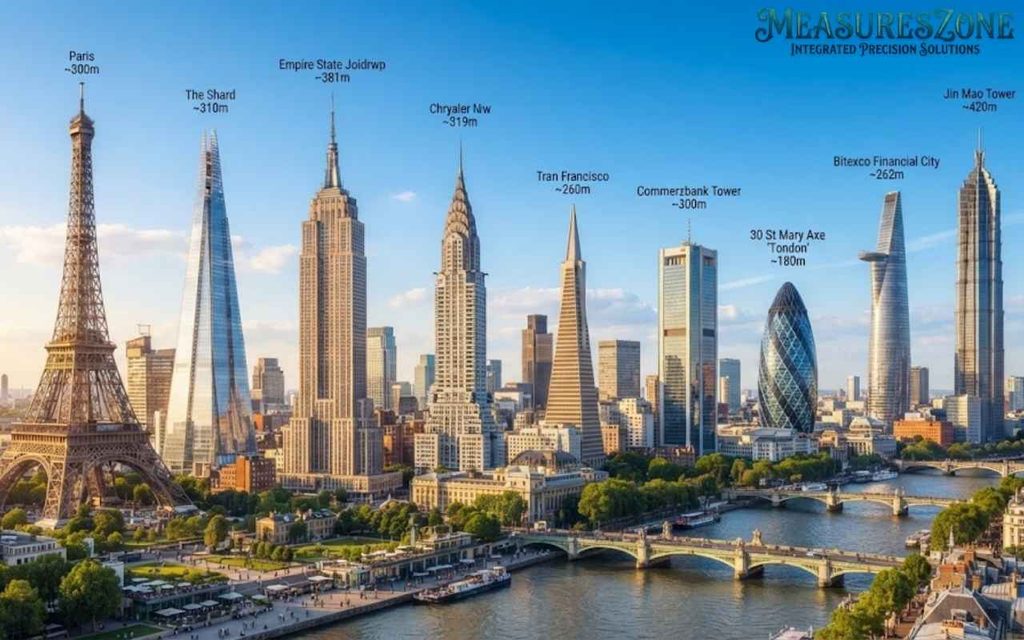
Quite a few real buildings sit near this benchmark.
The Shard, London
At 1,016 feet (310 meters), The Shard is the tallest building in the United Kingdom. Its glass peak was designed to look like a shard of glass rising from the Thames.
Chrysler Building: 1000 Feet and Beyond
The Chrysler Building reaches 1,046 feet (319 meters) with its steel spire. In 1930 it became the tallest building on Earth. Its Art Deco crown still draws photographers daily.
Empire State Building, New York
This icon stands 1,250 feet to its roof and 1,454 feet with the antenna. Its 86th-floor observation deck sits at 1,050 feet. Visitors there stand right above the 1000-foot mark.
Case Study: The Eiffel Tower
The Eiffel Tower tells the best story in this topic. When it opened in 1889 it rose to 1,024 feet, making it the first structure to pass 300 meters, according to the official Eiffel Tower website.
Not everyone cheered. A group of artists and writers called it “useless and monstrous” in a public protest. Today it stands about 1,083 feet with its antennas, and millions climb it every year. Every vertical landmark once looked like a risky idea.
See how long 1 inch is with everyday objects.
11 Real-Life Comparisons to Show How Tall 1000 Feet Is

Abstract numbers do not stick. Familiar references do. These everyday comparisons give you visual examples you can picture.
Almost Three Football Fields Stacked Vertically
An American football field measures 300 feet between goal lines. With both end zones the field length grows to 360 feet. Stack three football fields on end and you reach 1,080 feet. Stacked football fields come very close to our target at about 2.8 fields.
Six Olympic Pools Standing on End
An Olympic swimming pool runs 50 meters, which equals 164 feet. Most swimmers know that distance by heart. It is one long, lung-burning lap.
Six pools stand about 984 feet tall. That leaves only 16 feet to spare. Next time you finish six lengths, remember you just swam the 1000-foot height sideways.
Four Airbus A380s Nose to Tail
The Airbus A380 measures about 239 feet from nose to tail. It is the largest passenger jet in regular service. Line up four and you reach roughly 956 feet.
Now think about speed. At its cruising pace of around 560 miles per hour, an A380 covers 1,000 feet in little more than a second. On the ground, though, that same distance looks enormous.
Ten Blue Whales
Blue whales are the largest mammals ever recorded. They can reach about 98 feet in length. Ten blue whales placed head to tail stretch close to 980 feet. This animal size comparison shows how huge these marine giants are. Whale length alone covers a tenth of the distance.
Three Statues of Liberty
The Statue of Liberty stands 305 feet from the base of its pedestal to the tip of its torch. Stack three and a third of them and you reach 1,000 feet. It is a scale comparison most Americans know well.
The statue alone, from heel to torch, measures about 151 feet. The pedestal adds the rest. Strip the base away and you would need nearly seven statues to climb this high.
Nearly Two Washington Monuments
The Washington Monument rises 555 feet. Add a second one and you pass 1,000 feet with room to spare. Relative height makes the difference obvious.
Here is a fun twist. The monument held the title of tallest structure in the world until the Eiffel Tower opened in 1889. Today 1000 feet would tower over it by 445 feet.
The Towers of the Akashi Kaikyo Bridge
Japan’s Akashi Kaikyo Bridge has towers about 978 feet (298 meters) tall. They rank among the tallest suspension bridge towers in the world. Each one sits just 22 feet shy of the 1000-foot height.
Engineers had to design them for earthquakes and typhoon winds. In fact, the 1995 Kobe earthquake struck during construction and pushed the towers about a meter farther apart. The finished bridge opened in 1998.
The Millau Viaduct Mast
France’s Millau Viaduct reaches about 1,125 feet (343 meters) at the top of its tallest mast. That is 125 feet above our target. It even exceeds the roof of the Eiffel Tower.
The tallest pier alone stands about 804 feet (245 meters). The mast adds the rest. Few drivers realize they are crossing such a tall bridge as they cruise over the Tarn Valley.
Discover what 100 acres looks like in real life.
Staubbach Falls in Switzerland
Natural wonders count too. Staubbach Falls in the Lauterbrunnen Valley drops about 974 feet (297 meters). That is one of the highest free-falling waterfalls in Europe.
Its name means “dust brook” in German. Wind often turns the lower stretch into a fine mist before the water ever hits the ground. It is a graceful way to picture a vertical landmark.
A Modern Offshore Wind Turbine
The Vestas V236-15 MW turbine has a tip height around 920 feet (280 meters). That puts it within 80 feet of the 1000-foot benchmark. Wind turbines have grown huge over the past two decades.
The rotor spans 236 meters, or about 774 feet. The blades alone cover more than two and a half football fields end to end. A turbine this size is a true massive tower of the energy world.
The Eiffel Tower
We close with the classic. Its antenna-topped height of roughly 1,083 feet makes it the ultimate vertical landmark for this measurement. It is the easiest answer when someone asks how tall 1000 feet is.
The tower also moves with the weather. Heat makes its iron frame expand, and the top can rise by several inches on a hot summer day. Even a 1,000-foot structure breathes.
How Long Does It Take to Reach 1000 Feet?
Height feels different when you add time. Compare three ways to climb the same vertical measurement.
Climbing One Thousand Feet by Stairs
A standard stair riser is about 7.5 inches. So 1,000 feet needs roughly 1,600 steps.
The Empire State Building Run-Up covers 1,576 steps and about 1,050 feet of vertical gain. The fastest recorded time is 9 minutes and 33 seconds, set in 2003. Most casual climbers need 30 minutes or more.
Riding an Elevator
A standard high-speed elevator moves about 1,000 feet per minute. That is one minute for the full trip. Taipei 101 goes much faster. Its elevators travel up to 1,010 meters per minute, according to the Taipei 101 official site. You would cover 1,000 feet in about 18 seconds.
Hiking a Trail With 1000 Feet of Elevation Gain
A moderate hiker gains roughly 1,000 feet per hour on a trail. Steep switchbacks slow you down. Gentle ramps speed you up.
What Can You See From 1000 Feet Up?
Elevated viewpoints reward the effort. A simple formula shows how far you can see: distance in miles equals 1.22 times the square root of your height in feet. At 1,000 feet that gives about 38 miles on a clear day. Haze and humidity shorten this in practice.
Compare Gatorade bottle sizes and dimensions.
Panoramic Views From 1000 Feet Up
Many observation decks sit at or above the 1000-foot line:
- Empire State Building (86th floor): 1,050 feet
- One World Observatory, New York: about 1,250 feet
- CN Tower main pod, Toronto: about 1,136 feet
- Willis Tower Skydeck, Chicago: 1,353 feet
These viewing platforms and skyscraper observatories deliver panoramic views of whole city views at once. Rivers look like ribbons. Cars become moving dots.
Is 1000 Feet Considered Tall?
Yes. How tall depends on what you compare it to.
Compared With Average Buildings
Average buildings look tiny beside a 1000-foot structure. A typical two-story American house stands about 25 feet. You would need to stack 40 houses to reach the top.
Compared With a Modern Supertall Skyscraper
Skyscraper height keeps climbing worldwide. The Burj Khalifa in Dubai stands 2,717 feet, more than two and a half times our target. The CTBUH counts more than 200 supertall towers around the globe, so a 1000-foot skyscraper is now within reach for developers.
1000 Feet vs. Other Common Heights: Height Comparison Table
A good height comparison shows height differences at a glance.
| Landmark | Height | Compared with 1,000 ft |
|---|---|---|
| Statue of Liberty | 305 ft | 695 ft shorter |
| Washington Monument | 555 ft | 445 ft shorter |
| Space Needle | 605 ft | 395 ft shorter |
| Golden Gate Bridge towers | 746 ft | 254 ft shorter |
| 1,000 feet | 1,000 ft | Benchmark |
| Empire State Building (roof) | 1,250 ft | 250 ft taller |
| One World Trade Center | 1,776 ft | 776 ft taller |
| CN Tower | 1,815 ft | 815 ft taller |
| Burj Khalifa | 2,717 ft | 1,717 ft taller |
A 500-foot tower is half the height, so you need two to match. A 1,500-foot structure is fifty percent taller. At 2,000 feet you have exactly double, an extreme height reached by only a few buildings such as the Burj Khalifa and Merdeka 118 in Kuala Lumpur.
Engineering Facts About Vertical Construction at 1000 Feet
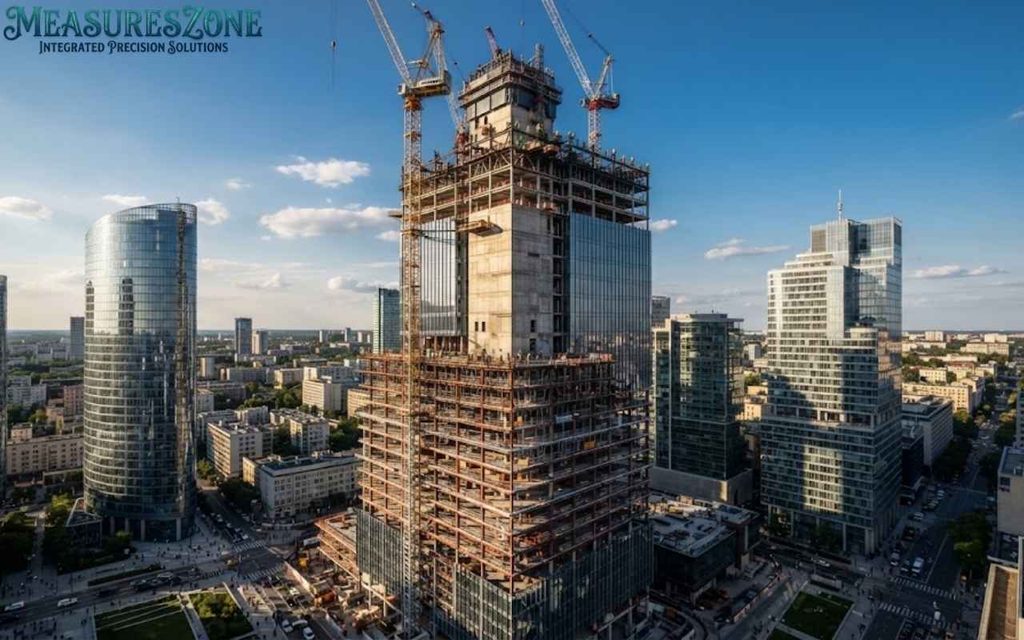
Building a high-rise skyscraper at this scale brings three big challenges.
- Wind: Tall buildings sway. Taipei 101 uses a tuned mass damper weighing 660 metric tons, about 730 tons, to calm the motion.
- Lightning: The Empire State Building takes roughly 25 strikes in a typical year. Lightning rods carry the charge safely to the ground.
- Aircraft safety: Structures taller than 200 feet usually need FAA notice and obstruction lighting. That is why red beacons blink atop every massive tower at night.
Aviation uses the 1000-foot figure too. Under 14 CFR 91.119, pilots must stay 1,000 feet above the highest obstacle over congested areas.
Discover what 12 cm looks like with common objects.
FAQs About 1000 Feet
These frequently asked questions cover walking time, city block comparisons, and falling distances for 1,000 feet.
How long does it take to walk 1,000 feet?
At an average walking speed of 3 mph, it takes about 3 minutes and 45 seconds to walk 1,000 feet. At a brisk pace of 3.5 mph, it takes roughly 3 minutes and 15 seconds.
How many city blocks is 1,000 feet?
In Manhattan, a typical short north-south block is about 264 feet, so 1,000 feet equals roughly four blocks. A long east-west block is about 900 feet.
How long does it take to fall 1,000 feet?
Without air resistance, an object takes about 8 seconds to fall 1,000 feet. In real conditions, air resistance slows the fall, making the time longer.
Final Thoughts
One thousand feet is more than a number. It is an architectural achievement where engineering becomes art. Whether you picture three football fields, ten blue whales, or the Eiffel Tower, the size comparisons all lead to the same feeling: wonder.
Next time you see a towering building, guess its height. Then check the real figure. Your eye for height measurement will sharpen fast.
See what 250 ml looks like in everyday objects.

David John is an experienced blogger and the admin of the Measurements category at Measures Zone. He shares accurate and easy to understand measurement guides for readers.