

If you have ever tried to jam a Charizard into the wrong sleeve, you already know why Pokémon card dimensions matter more than most people think. Get the size wrong and you end up with a card that slides around in its sleeve, does not sit flush in a binder, or worse, does not pass muster at a sanctioned tournament.
This guide covers everything worth knowing about Pokémon card sizes. The official measurements, how they stack up against other trading card games, what jumbo and promo variants look like, and how to use dimensions to sniff out a fake. No filler, no guesswork, just the numbers you actually need.
Standard Pokémon Card Size
Here is the quick breakdown:
| Measurement | Value |
|---|---|
| Width | 2.5 in / 63.5mm |
| Height | 3.5 in / 88.9mm |
| Thickness | ~0.30mm (roughly 20–24pt) |
| Corner radius | ~1/8 in (3.2mm) |
| Weight | Around 1.8 grams per card |
Pokémon Card Dimensions: Exact vs. Rounded Figures
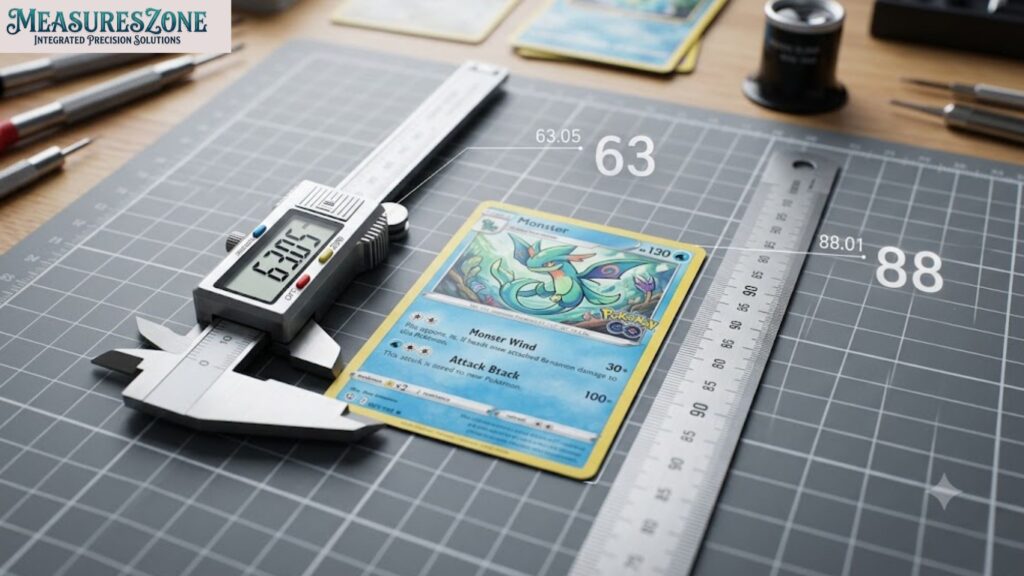
The Exact Measurement
The precise Pokémon card measurements, down to the decimal, are 63.5mm wide by 88.9mm tall. This is the number that professional grading companies like PSA and BGS actually use. When a card gets graded, its centering is measured against this exact figure, because even a fraction of a millimeter can shift a grade from a 9 to a 10.
The Rounded Figure
Walk into any card shop and you will see sleeves, toploaders, and storage boxes labelled 63mm x 88mm. That is the rounded, manufacturing-friendly version of the same measurement. It is close enough for packaging purposes and it is the number most casual collectors memorize.
Why the Difference Exists
Manufacturing does not need decimal point precision. A sleeve company printing “63mm x 88mm” on a box is not lying, it is just simplifying. Grading, on the other hand, is a precision business, so PSA and BGS stick with the exact 63.5mm x 88.9mm spec.
Here is the same size laid out across every unit you are likely to need:
| Unit | Width | Height |
|---|---|---|
| Inches | 2.5 in | 3.5 in |
| Millimeters | 63.5mm | 88.9mm |
| Centimeters | 6.35cm | 8.89cm |
| Rounded (community standard) | 63mm | 88mm |
Whichever version you use, the Pokémon card width and height ratio stays the same, and that consistency is exactly what makes the format so collector-friendly.
Pokémon Card Thickness and Weight
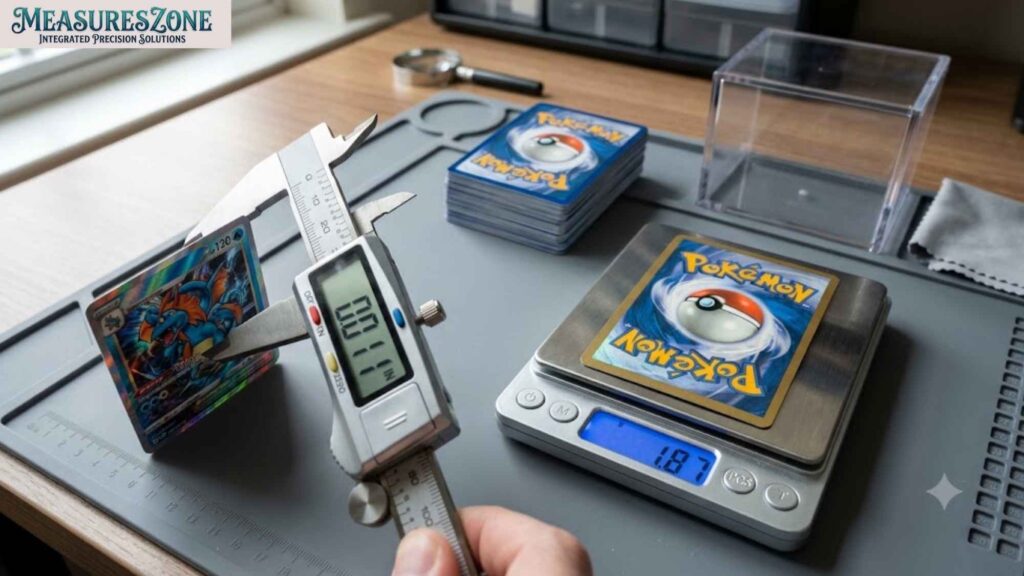
Width and height get most of the attention, but Pokémon card thickness matters just as much if you are buying protective gear.
Standard cards run about 0.30mm thick, which lines up with the 20pt–24pt range used in the trading card industry (the “pt” here refers to thousandths of an inch, a holdover from printing terminology). Holographic and textured cards can run thicker, sometimes reaching 35pt, because of the extra foil layer bonded to the surface.
A few practical takeaways:
- Standard cards (20–24pt): Fit comfortably in any 35pt toploader with a penny sleeve underneath.
- Holo/textured cards (up to 35pt): May feel snug in standard-thickness toploaders and benefit from a slightly larger option.
- Weight: A single standard card weighs approximately 1.8 grams, light enough that a stack of 60 (a full tournament deck) still fits comfortably in a small deck box.
Has Pokémon Card Size Ever Changed?
Short answer: no. The standard Pokémon card size has stayed exactly the same since the Pokémon Trading Card Game launched in Japan in 1996, and later internationally in 1999. Every set since, from the original Base Set to the newest Scarlet & Violet expansions, sticks to that same 2.5″ x 3.5″ footprint.
That kind of long-term consistency is rare in collectibles, and it is a big part of why the hobby works so smoothly. A sleeve you bought during the Base Set era in the late 90s will still fit a card printed this year. Try doing that with, say, phone cases across two decades of models.
Pokémon Card Size Chart: Every Variant Explained
Not every Pokémon card follows the standard mold. Here is the full Pokémon card size chart, covering every variant you are realistically going to run into.
| Card Type | Dimensions (inches) | Dimensions (mm) | Notes |
|---|---|---|---|
| Standard | 2.5 x 3.5 | 63.5 x 88.9 | Every common, rare, holo, and ultra-rare |
| Modern Jumbo | 5.75 x 8.0 | 146 x 203 | Common promotional oversized format |
| Large Display Jumbo | 8 x 11 | 203 x 279 | Big-box promotional and display-only cards |
Standard Cards
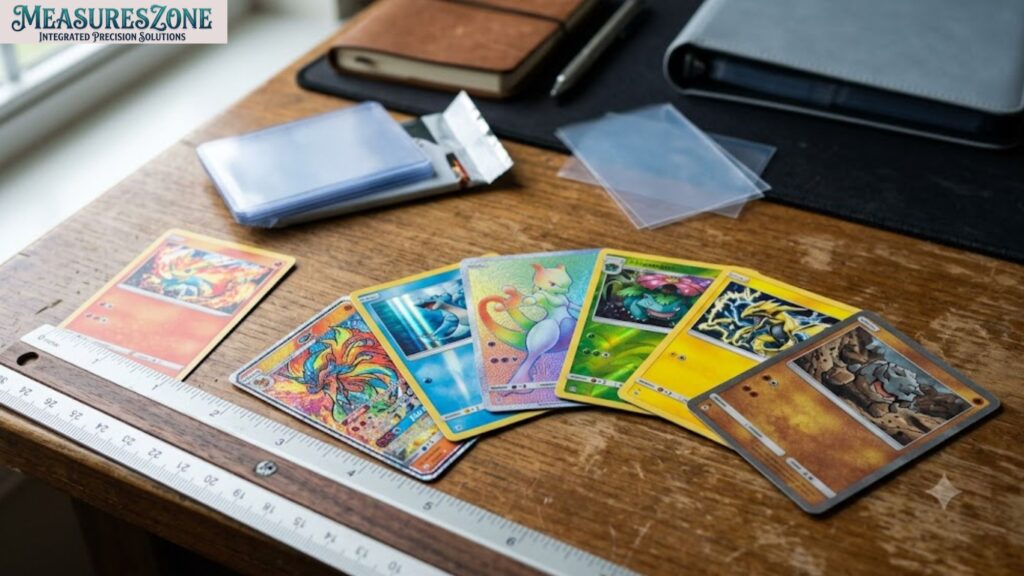
This is the size that makes up the vast majority of every Pokémon collection on earth. Commons, rares, full-arts, alt-arts, and secret rares all print at the same 2.5″ x 3.5″ spec. There is no rarity-based size difference; a $2 common and a $5,000 rare secret rare are physically identical in size.
Find easy ways to visualise 2 inches.
Jumbo Promo Cards
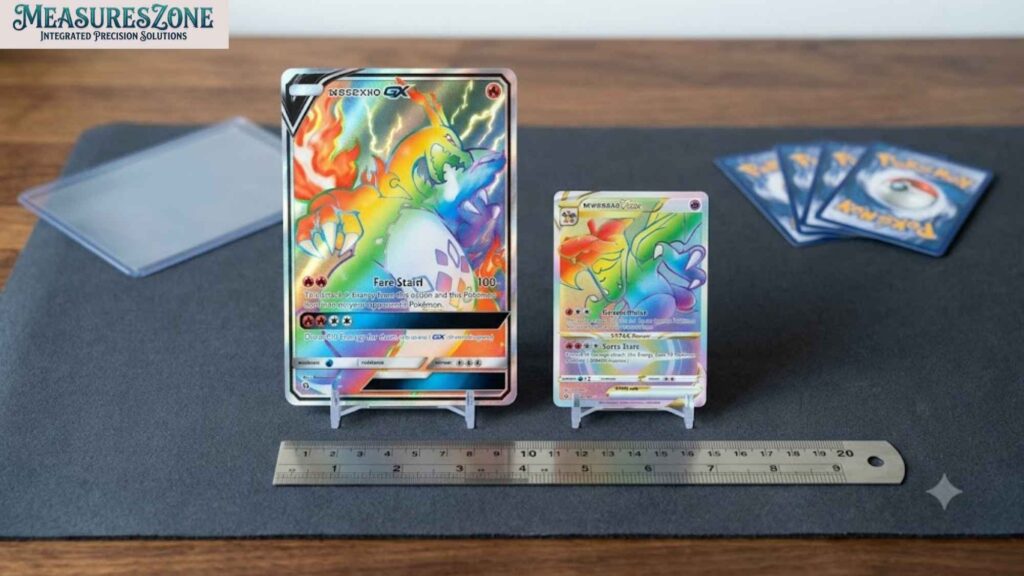
Jumbo Pokémon cards are the oversized promotional versions you sometimes get with special box sets, at events, or as store promos. They are built for display, not for gameplay, and are not tournament-legal in official play.
There are two distinct jumbo categories worth knowing:
- Modern jumbo cards typically measure 5.75″ x 8″ (146mm x 203mm), roughly double the linear size of a standard card.
- Large display jumbo cards, used for bigger promotional pieces, can reach 8″ x 11″ (203mm x 279mm), closer to a sheet of printer paper.
If you are shopping for jumbo card sleeves, always check which category your card belongs to first. A sleeve sized for the 5.75″ x 8″ format was not fit the larger 8″ x 11″ promos, and vice versa.
Collector’s note: Jumbo cards are fun to display, but they are not an investment shortcut. Because they are produced in far smaller print runs and were never meant for gameplay, their resale value depends entirely on the specific promotion, not on the card being “bigger” or rarer by default.
Pokémon Cards in Digital Formats
If you design custom cards, fan art, or proxy prints, you will need to know how Pokémon card dimensions in pixels translate across resolutions.
Pixel Dimensions by Resolution
| Resolution | Purpose | Width (px) | Height (px) |
|---|---|---|---|
| 300 DPI | Print-quality design | 750px | 1050px |
| 72 DPI | Web/screen display | 180px | 252px |
For anything you intend to print, always work at 300 DPI. Screen resolution (72 DPI) is fine for previews or web thumbnails, but printing at that resolution will produce a blurry, pixelated card.
Print Bleed Size
If you are sending a design to a physical printer, add bleed, which is extra image area trimmed off after printing to avoid unprinted white edges. Standard bleed for a Pokémon-style card is about 0.125 inches per side, which bumps your canvas up to:
- 825px x 1125px at 300 DPI
Skipping bleed is one of the most common mistakes first-time custom card designers make. Without it, any tiny misalignment during trimming leaves a thin white sliver along the card’s edge.
Setting Up a Canvas for Procreate or Photoshop
When building a Pokémon card dimensions for Procreate template, set your canvas to 750px x 1050px at 300 DPI for a bleed-free design, or 825px x 1125px if you are accounting for bleed. Keep your text and important artwork at least 3–4mm inside the trim line so nothing important gets cut off during printing.
See how long 6 inches is using everyday objects.
How Pokémon Card Sizes Compare to Other Trading Cards
This is one of the most searched comparisons in the hobby, and for good reason: card games share a lot of accessories, but only if the sizes actually match.
Standard TCG Card Size Comparison
| Game | Dimensions (inches) | Dimensions (mm) | Same as Pokémon? |
|---|---|---|---|
| Pokémon TCG | 2.5 x 3.5 | 63.5 x 88.9 | — |
| Magic: The Gathering | 2.5 x 3.5 | 63 x 88 | Yes |
| Yu-Gi-Oh! | 2.32 x 3.39 | 59 x 86 | No, smaller |
| Standard playing cards | 2.5 x 3.5 | 63 x 88 | Yes |
The takeaway here is simple: standard trading card dimensions across most modern TCGs, including Magic: The Gathering and standard playing cards, line up with Pokémon almost perfectly. That means sleeves, deck boxes, and binders are largely interchangeable between those games.
Yu-Gi-Oh! is the outlier. Its cards run noticeably smaller, at roughly 59mm x 86mm, so sleeves made for Pokémon or Magic will not fit Yu-Gi-Oh! cards snugly. If you play multiple games, this is the one mismatch to watch for when buying storage in bulk.
Japanese vs. International Pokémon Card Sizes

Here is a myth worth busting directly: Japanese Pokémon cards are the same size as international ones. Unlike Yu-Gi-Oh!, where Japanese and English cards actually differ in dimensions, Pokémon has kept its standard Pokémon card measurement identical across every region: English, Japanese, Korean, and Chinese cards all print at 63.5mm x 88.9mm.
This matters practically because it means:
- The same sleeves and toploaders work for both Japanese and English cards
- Binders do not need region-specific pages
- Grading standards apply identically regardless of print language
If you ever see a source claiming Japanese Pokémon cards use a smaller ~59mm x 86mm format, that figure actually belongs to Yu-Gi-Oh!, not Pokémon. It is an easy mix-up, but worth correcting since it leads people to buy the wrong sleeves.
Visual Size Comparisons: How Big Is a Pokémon Card, Really?
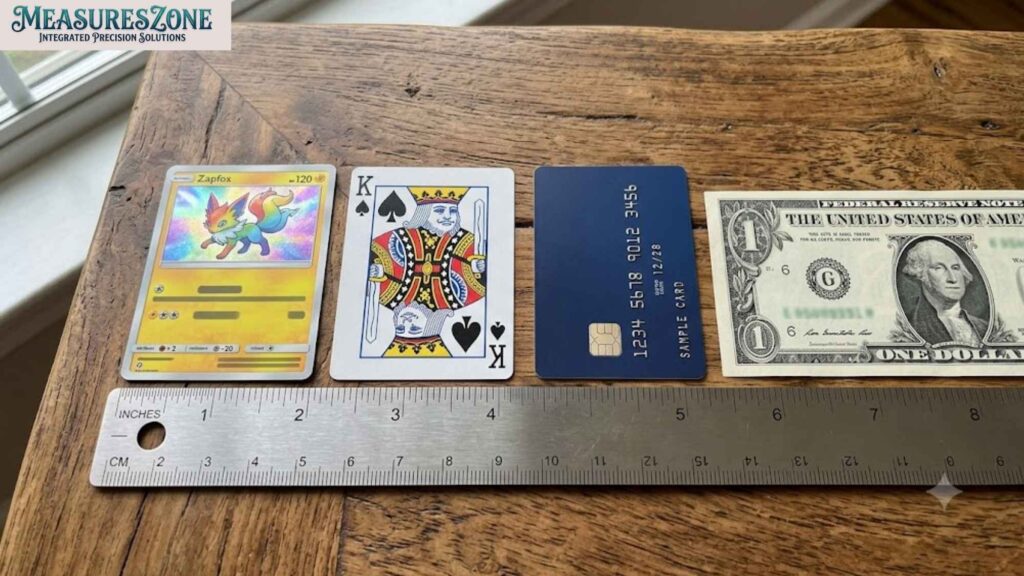
Numbers on a page do not always click, so here is how a standard Pokémon card stacks up against everyday objects:
- A standard playing card: Essentially identical in size, this is the easiest mental shortcut if you have ever held a deck of cards.
- A credit card: Slightly smaller and narrower, at 3.37″ x 2.13″, a credit card is shorter in height but wider in comparison.
- A US dollar bill: For scale only. A dollar bill measures 2.61″ x 6.14″, noticeably longer and narrower than a Pokémon card.
Holding a card next to any of these gives you an instant, no-ruler-needed sense of scale, which is handy the next time you are explaining sizes to someone new to the hobby.
Find the exact sizes and dimensions of Monster cans.
Pokémon Card Sleeves and Storage Sizing
Getting Pokémon card sleeves right is where a lot of new collectors go wrong, mostly because “standard” sleeve sizes leave slightly more room than the card itself, on purpose.
Sleeve Sizing
| Sleeve Type | Dimensions | Purpose |
|---|---|---|
| Standard outer sleeve | 66mm x 91mm | General protection, tournament play |
| Perfect Fit inner sleeve | 64mm x 89mm | Snug fit, used under outer sleeves |
| Jumbo sleeve | ~6″ x 8.25″ or larger | Fits modern jumbo promo cards |
The small gap between a card’s actual size and its sleeve’s interior dimensions is not a manufacturing flaw, it is intentional. Perfect Fit inner sleeves are designed to hug the card tightly with almost no wiggle room.
standard outer sleeves leave enough clearance for smooth, fast shuffling during a tournament. Competitive players often “double sleeve,” using a Perfect Fit sleeve inside a standard outer sleeve, to get both a snug fit and tournament-legal thickness in one package.
Toploader Sizes
For rigid, long-term protection, a standard 3″ x 4″ toploader (commonly labelled 35pt) is the go-to size for a single sleeved card. If your card is thicker than average, such as a heavily textured holo, size up to a 55pt or 75pt toploader so the card is not forced or bent while sliding in.
Binder Pages
Standard 9-pocket binder pages are built around the 2.5″ x 3.5″ standard, meaning sleeved or unsleeved cards both fit comfortably without warping the pocket over time.
Using Dimensions to Spot a Fake Pokémon Card
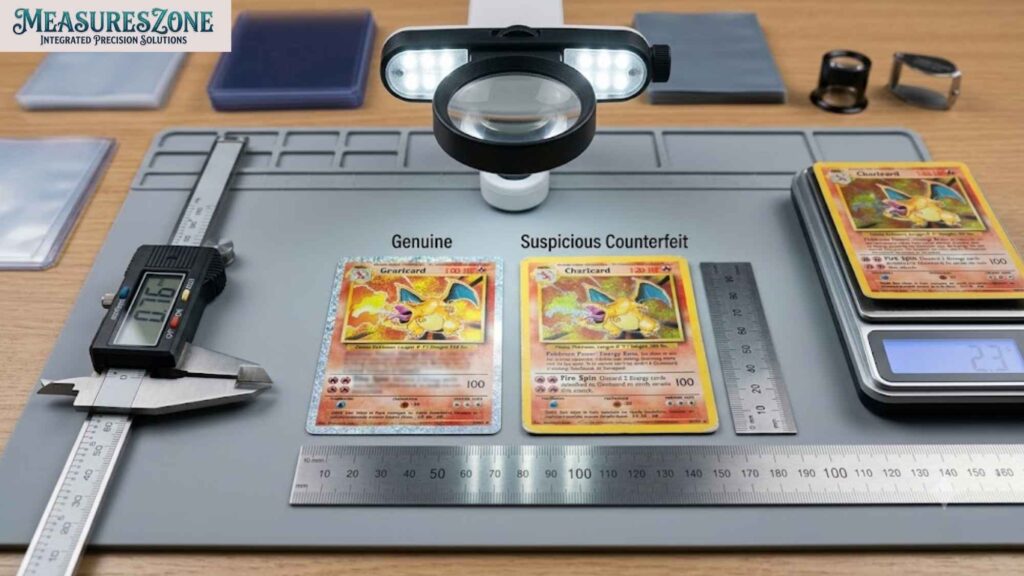
Counterfeit Pokémon cards have gotten more convincing over the years, but dimensions remain one of the fastest, most reliable ways to catch one. Fakes almost always deviate from the real spec in at least one of these areas.
Width and Height
Genuine cards measure exactly 2.5″ x 3.5″ (63.5mm x 88.9mm). Even a 1–2mm deviation, easily checked with a ruler, is a strong red flag.
Thickness
Authentic cards sit around 0.30mm thick. Many counterfeits are noticeably thinner (cheap paper stock) or thicker (low quality cardboard laminated poorly), and the difference is often obvious just by feel once you have handled a genuine card.
Corner Radius
Real Pokémon cards are die-cut with a consistent, machine-precise rounded corner, about 1/8 inch. Fakes frequently show uneven rounding, sharper corners, or slightly asymmetrical cuts, since cheap counterfeiting operations rarely invest in matching die-cutting equipment.
The Light Test
This one’s simple and does not require any tools. Hold the card up to a bright light source. Genuine Pokémon cards have an opaque black core layer sandwiched between the front and back paper stock, which blocks light almost completely. Many counterfeits skip this layer entirely, so light passes through visibly, especially around the edges.
Quick fake-detection checklist:
- Measure width and height against 2.5″ x 3.5″ (63.5mm x 88.9mm)
- Check thickness against ~0.30mm
- Inspect corner rounding for consistency
- Hold up to light and check for the opaque black core
- Compare weight against a known genuine card (~1.8 grams)
If a card fails two or more of these checks, treat it as counterfeit until proven otherwise.
Discover what 100 feet looks like in real life.
How to Measure a Pokémon Card Without Callipers
You do not need precision lab equipment to check a card’s size at home. Here is a simple, practical method:
- Use a standard ruler. A basic ruler measured in millimetres is accurate enough to catch any card that is clearly off-spec.
- Compare against a known genuine card. Place a card you are confident is authentic directly on top of the one you are checking. Any visible size gap along the edges is an instant red flag.
- Print a to-scale template. Search for a printable 63.5mm x 88.9mm template, print it at 100% scale (never “fit to page”), and lay your card directly on top to check alignment.
- Check the corners specifically. Even when width and height look correct, corner rounding is one of the hardest details for counterfeiters to replicate precisely.
This was not replace professional authentication for high-value cards, but it is more than enough to catch the majority of counterfeits circulating in casual trading and resale.
pokémon Card Quiz
1. What are the official dimensions of a standard Pokémon card?
A) 2.5″ x 3.5″ (63.5mm x 88.9mm)
B) 2.25″ x 3.25″ (57mm x 82mm)
C) 3″ x 4″ (76mm x 102mm)
D) 2.75″ x 3.75″ (70mm x 95mm)
2. Roughly how thick is a standard Pokémon card?
A) 0.10mm
B) 0.30mm
C) 0.75mm
D) 1.2mm
3. Which trading card game uses the SAME card dimensions as Pokémon?
A) Yu-Gi-Oh!
B) Magic: The Gathering
C) Neither — all TCGs differ
D) Only Japanese Yu-Gi-Oh!
4. What is true about Japanese vs. international Pokémon card sizes?
A) Japanese cards are smaller, like Yu-Gi-Oh!
B) International cards are smaller
C) They are exactly the same size worldwide
D) Only holo cards differ in size by region
5. What size is a standard toploader designed to fit?
A) 2″ x 3″
B) 3″ x 4″
C) 4″ x 6″
D) 5″ x 7″
6. At 300 DPI, what pixel dimensions should a print-ready Pokémon card design use?
A) 300px x 400px
B) 500px x 700px
C) 750px x 1050px
D) 1000px x 1400px
Answer Key
- A) 2.5″ x 3.5″ (63.5mm x 88.9mm)
- B) 0.30mm
- B) Magic: The Gathering
- C) They are exactly the same size worldwide
- B) 3″ x 4″
- C) 750px x 1050px
Conclusion
Getting the Pokémon card dimensions right is not just trivia to impress fellow collectors, it is what determines whether your sleeves fit, your custom prints come out crisp, and that card you are eyeing online is worth the money. Once you know the real standard Pokémon card size of 2.5″ x 3.5″ (63.5mm x 88.9mm), most of the guesswork in this hobby disappears.
Keep the basics close: the same size across every region, a couple of jumbo variants that look great but are not tournament-legal, and a quick light test whenever something feels off. Nail those, and you will never second-guess a sleeve purchase or squint at a listing wondering if the numbers add up.
Frequently Asked Questions
Got a few more questions about Pokémon card sizing? Here are some quick answers to things we have not already covered above.
1. Do PSA and BGS use different size standards when grading?
No, both use the same exact spec (63.5mm x 88.9mm) for centering and measurement purposes. Grading differences come from centering, surface, and edge wear, not from a different size standard.
2. Are vintage Base Set cards from 1999 the same size as modern cards?
Yes, the size has not changed since launch. A sleeve bought decades ago will still fit a card printed today.
3. Do oversized jumbo cards affect a card’s resale value?
Not by size alone. Jumbo cards are valued based on the specific promotion and print run they came from, not simply because they are bigger.
4. Is a thicker card always a sign it is fake?
Not necessarily. Textured or heavily foiled holo cards naturally run thicker than standard cards, so thickness alone should be checked alongside other tests, like the light test or corner radius.
5. Do all Pokémon sets use the same corner rounding?
yes. Every officially printed set uses the same die-cut corner radius, which is one reason inconsistent corners are such a reliable red flag on counterfeits.
See how big 10 inches really is with everyday objects.

Sam Glen is an experienced blogger and the author of the Dimension category at Measures Zone. He specializes in creating accurate, easy-to-understand size and dimension guides, helping readers quickly find reliable information for everyday objects and products.