

If you have ever seen the number “69 inches” and paused to picture it, you are not alone. It is a height that shows up constantly in furniture specs, shipping dimensions, height charts, and even in conversations about average adult man height. But converting inches into a mental image is not always easy.
This guide breaks down exactly what 69 inches looks like, how it converts across measurement systems, and which everyday objects match it almost perfectly.
What Does 69 Inches Actually Mean?
69 inches tall is the same as 5 feet 9 inches, which happens to be one of the most talked-about heights in the world. Why? Because it sits right at (or extremely close to) the average male height in the United States, according to long-running CDC health survey data. That is not a coincidence worth ignoring. It is exactly why so many people search for this number in the first place.
In simpler terms, a 69 inch height is not unusually tall or unusually short. It is the height equivalent of “right in the middle,” which makes it a genuinely useful reference point for comparing objects, furniture, and even other people.
Learn about Chicago’s size, geography, and history.
Quick Reference: 69 Inches in Centimeters, Feet, and Meters
Before diving into real-world comparisons, here is the height conversion breakdown you are probably looking for:
| Unit | Value |
|---|---|
| Feet & Inches | 5 feet 9 inches |
| Centimeters | 175.26 cm |
| Meters | 1.75 meters |
| Decimal Feet | 5.75 feet |
| Millimeters | 1,752.6 mm |
| Yards | 1.9167 yd |
Here is the math, in case you want to double check it yourself: since one foot equals 12 inches, 69 inches divided by 12 gives you 5.75 feet, or 5 feet 9 inches. To get 69 inches in centimeters, multiply by 2.54 (the standard inches to centimeters conversion factor), and you land on 175.26 cm, often rounded to 175 cm in casual conversation.
Quick tip: If you ever need a fast mental shortcut for metric conversion, remember that 1 inch equals roughly 2.5 cm. It is not perfectly precise, but it gets you close enough for everyday estimates.
How 69 Inches Compares to Average Height

This is where the number gets genuinely interesting. A 5’9 height is remarkably close to national averages for adult men in the U.S., UK, and several other countries. According to CDC health data, the average adult man in America stands somewhere around 69 inches (175 cm), give or take a fraction of an inch depending on the survey year.
For women, 69 inches sits noticeably above average. The typical adult female height in the U.S. runs closer to 63–64 inches, meaning someone at 69 inches would be considered tall by comparison.
Here is how it breaks down by general population framing:
- For men: Right around average, not tall, not short, just typical.
- For women: Noticeably above average, often perceived as tall.
- Globally: Slightly above the world average for men, which tends to run a bit lower than U.S. figures due to regional variation.
None of this means much on its own, though. Numbers only become meaningful once you can see them. That is where real objects come in.
Learn about Florida’s size, geography, and more.
Real-World Objects That Are Around 69 Inches Tall
Numbers on a page rarely stick. Real world objects, on the other hand, are something you have probably stood next to. Below are genuine, verifiable 69 inch objects you can use as a mental measuring stick.
1. A Standard Interior Door

Most interior doors run between 78 and 80 inches, but shorter interior doors, especially in older homes, closets, or utility spaces, often sit closer to the high 60-inch range. If you have ever ducked slightly walking through an older doorway, you have likely experienced something close to a 69 inch measurement in real time.
2. A 69 Inch Floor Mirror
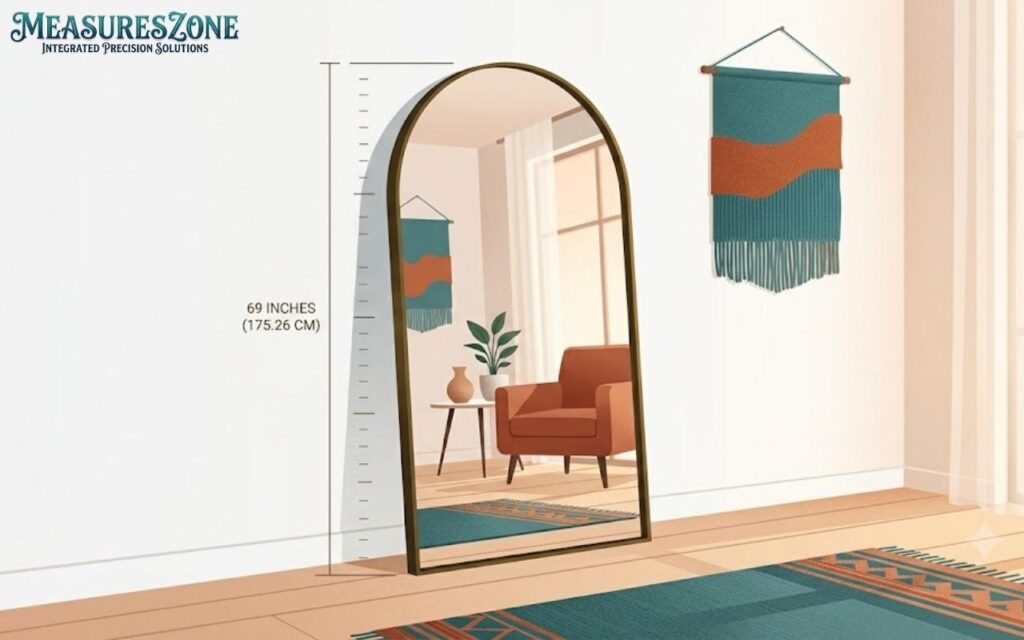
Full-length mirrors are one of the most common 69 inch objects sold today. A 69 inch floor mirror, sometimes styled as an arched mirror or bedroom mirror, is tall enough to reflect a full adult body from head to shoe.
That is exactly why furniture brands standardize around this height. If you are shopping for a full length mirror, this is one of the most popular size brackets on the market.
3. 69 Inch Wire Shelving

Commercial and home organization brands frequently sell wire shelving and storage rack units in this height range. A 5 tier rack built for garages, pantries, or stockrooms often lands close to 69 inches, offering vertical storage without requiring a stepladder to reach the top shelf.
This kind of commercial shelving is popular precisely because it maximizes storage without hitting the ceiling in standard rooms.
4. A Garden Privacy Trellis

Outdoor garden trellis structures, the kind used for climbing plants like clematis, jasmine, or climbing roses, are frequently built around 69 inches tall.
This height works well as a garden screen because it is tall enough to create real outdoor privacy from a neighboring yard or patio, without requiring permits that taller fencing sometimes does in residential areas.
Visualize 5 inches with everyday objects.
5. A Kayak Length Comparison

While full kayaks usually run much longer than 69 inches, several compact or child-sized recreational kayaks land close to this measurement, making it a useful comparison for anyone shopping for storage space in a garage or shed.
6. A Queen Mattress, Turned Sideways
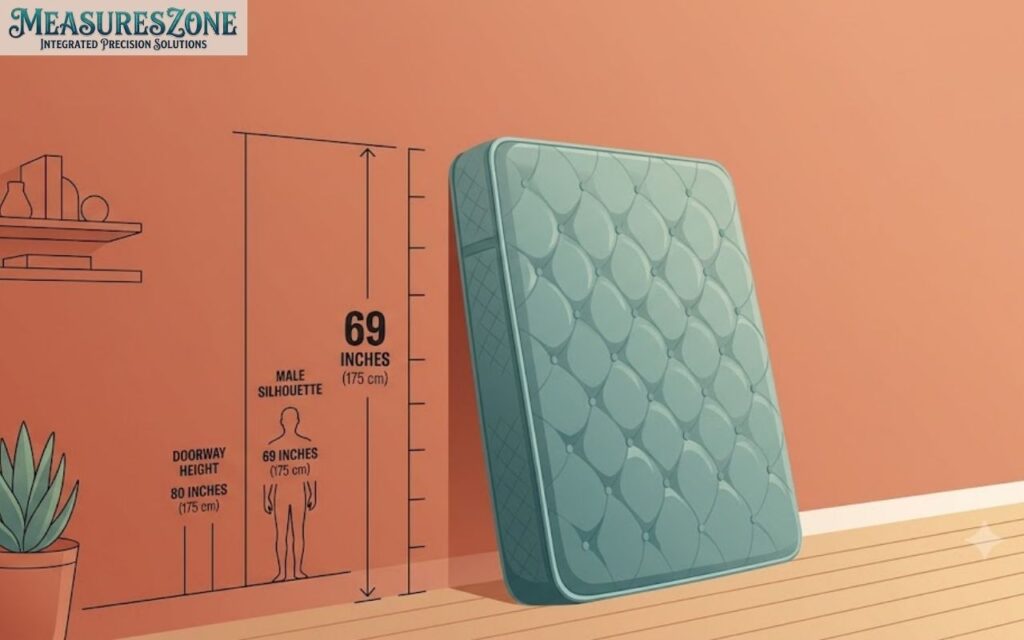
A queen mattress measures 60 inches wide, closer than most people expect to the 69-inch mark. Turn it on its side, and you will notice it is not far off from a 69 inch height at all, which is a surprisingly useful visual for anyone trying to picture the number in a bedroom setting.
7. Refrigerator Height

Many standard kitchen refrigerators fall between 66 and 70 inches tall, putting a large number of common fridges directly in line with a 69 inch height. Next time you are in a kitchen, take a glance. You are likely looking at close to this exact measurement.
Learn Red Bull can sizes and dimensions.
8. An NBA Player at the Shorter End

While professional basketball skews tall, a handful of historical NBA players have measured right around 5’9″, making them shorter than the average player but still professional athletes. It is a solid reminder that a 69 inch height is completely normal, even in a sport dominated by significantly taller competitors.
9. TV Screen Size Comparison
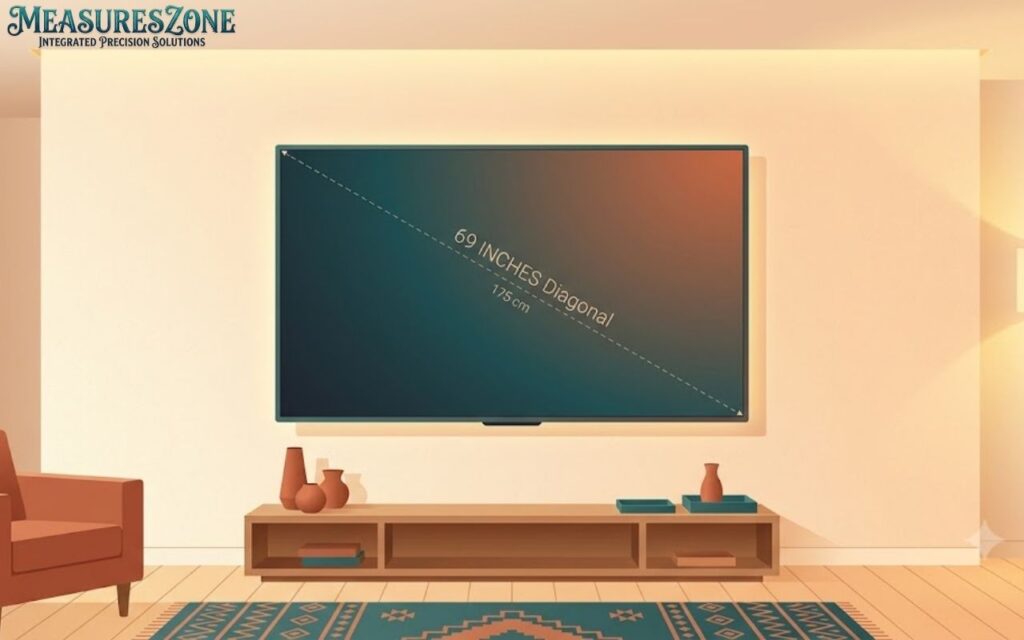
Television sizes are measured diagonally, and while a 69 inch TV is not a standard retail size (manufacturers typically round to 65″ or 70″), it is still useful for comparison.
A TV with a 69-inch diagonal screen, using standard 16:9 TV screen dimensions, would measure roughly 60 inches wide and about 34 inches in TV height. That is a helpful way to visualize how wide 69 inches actually spreads out horizontally versus vertically.
Where 69 Inches Actually Matters in Real Life
This is not just trivia. A 69 inch measurement shows up in practical decisions more often than people realize:
- Furniture planning: doorway clearance, closet rod height, and shelving placement all depend on knowing exact vertical space.
- Shipping and freight: many carriers cap box dimensions, and 69 inches is close to common maximum limits for oversized parcels.
- Clothing and height charts: pant inseams, dress lengths, and sizing guides frequently reference 5’9″ as a baseline.
- Home improvement: trellises, shelving, and mirrors are commonly manufactured at this height because it balances usability with standard ceiling clearances.
How to Visualize 69 Inches Without a Tape Measure
If you do not have a measuring tape handy, try this: stand next to a standard kitchen counter (about 36 inches) and mentally stack it twice. You will land almost exactly at 69 inches high. Alternatively, picture a 69 inch floor mirror leaning against a wall; that reflection point is your visual benchmark.
Quiz: Test Your Knowledge on 69 Inches
1. What is the quickest way to convert inches to centimetres in your head?
a) Divide by 12
b) Multiply by roughly 2.5
c) Multiply by 10
d) Subtract 32 and divide by 2
2. What is 69 inches in feet and inches?
A) 5 feet 6 inches
B) 6 feet 1 inch
C) 5 feet 9 inches
D) 5 feet 11 inches
3. According to CDC data referenced in the article, 69 inches is closest to which group’s average height?
A) Average adult woman in the U.S.
B) Average adult man in the U.S.
C) Average teenager in the U.S.
D) Average global height for both sexes combined
4. Which of these is NOT listed as a real-world object close to 69 inches tall?
A) A garden privacy trellis
B) A 5-tier wire shelving unit
C) A standard dining table
D) A full-length floor mirror
5. Using the conversion factor mentioned in the article, roughly how many centimeters does 1 inch equal?
A) 1.5 cm
B) 2.0 cm
C) 2.54 cm
D) 3.0 cm
Answers
- b) Multiply by roughly 2.5
- C) 5 feet 9 inches
- B) Average adult man in the U.S.
- C) A standard dining table
- C) 2.54 cm
Final Takeaway
A 69 inch height is not just a random number. It is the same as 5 feet 9 inches, or 175.26 cm, and it happens to align closely with the average adult man in the U.S.
Whether you are shopping for a 69 inch floor mirror, sizing up a garden trellis, or just trying to picture how tall someone or something is, this measurement sits right in that comfortable, relatable middle ground. Tall enough to notice, common enough to be everywhere.
Frequently Asked Questions About 69 Inches
1. Is 5 feet 9 inches considered tall for a man?
Not particularly. It is close to the U.S. average, so most men at this height are seen as average rather than tall or short. Perception often shifts by region, since average heights vary from country to country.
2. Does 69 inches round to a different number in metric countries?
Yes, in casual use. While the precise conversion is 175.26 cm, most metric countries round it to 175 cm on official forms, ID cards, and medical charts for simplicity.
3. Can height change throughout the day?
Yes. Most people are slightly taller in the morning and lose up to half an inch by evening due to spinal compression from gravity, so a “69 inch” measurement can vary slightly depending on when it is taken.
4. Do shoe lifts or insoles actually add a full inch to height?
Rarely. Most lifts add somewhere between a quarter-inch and three-quarters of an inch in practical, walkable comfort, even if packaging advertises a full inch or more.
5. Is self-reported height usually accurate?
Not always. Studies on self-reported measurements consistently show a small upward bias, meaning people often round up by half an inch to a full inch compared to their actual measured height.
Learn standard Pokémon card sizes and dimensions.

David John is an experienced blogger and the admin of the Measurements category at Measures Zone. He shares accurate and easy to understand measurement guides for readers.